“Man serves the interests of no creature except himself. And among us animals let there be perfect unity, perfect comradeship in the struggle. All men are enemies. All animals are comrades.” Animal Farm (1945)
“This high-minded speech of the deputy hackney-coach-horse seemed to electrify all present; and a most touching scene took place, of the reconciliation of animals formerly considered bitter enemies. The cow and the bull embraced the dog; the dog, the sheep and the cat; and the cat wept, in tears of fraternity and union, over the bosom of the rat and the mouse. The ferret shook hands with the rat, and the terrier kissed him also; till all present, in one unanimous sentiment, held up their tails to heaven, and exclaimed in the most determined tone, “We swear eternal friendship!” Never was I more touched; tears of sentimentality rolled down my cheek; and I felt for the first time the blessing of a virtuous friendship, in a cause which liberty has approved, and courage protected.” The Rebellion of the Beasts (1825)
In celebration of the 80th anniversary of George Orwell’s fable, Animal Farm: A Fairy Story, I highlighted some of the more obscure stories about the publishing history and genesis of the novel. Since publishing that article, a rare first edition of The Rebellion of the Beasts; or The Ass is Dead! Long Live the Ass!!! written “by a Late Fellow of St. John’s College, Cambridge” has been added to my collection and is worthy of reflection with Orwell’s fable in mind.
No great act of scholarship uncovered this novel attributed to the English essayist, poet, journalist and literary critic, Leigh Hunt (1784-1859). It was a product of bibliomania.
Alerts are automated notifications which assist collectors to get the jump on other bibliophiles when a long sought-after book, edition, author or subject appears on the market. The trick is to employ keywords which successfully access the metadata supplied by the antiquarian bookseller. Alerted, one either manages to snaffle the book, sadly passes due the exorbitant price or finds, in my case, that someone in the northern hemisphere received their notification and procured the treasure while this Antipodean slumbered.
Unexpectedly, the seller accepted my ludicrously meagre offer. This was surprising as although the book needs to be rebound, it is exceedingly rare with only two previously sold at auction (that I could find) in 1967 and 2022. The vendor could not provide much provenance nor any wisdom on the ink signature dated 1825*.
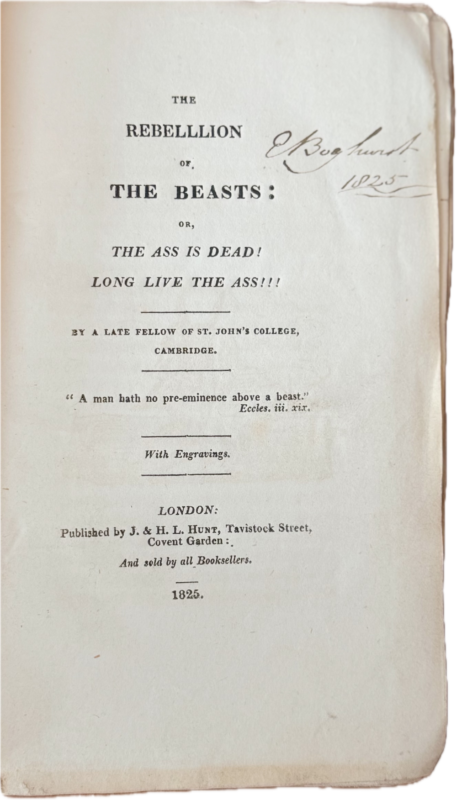
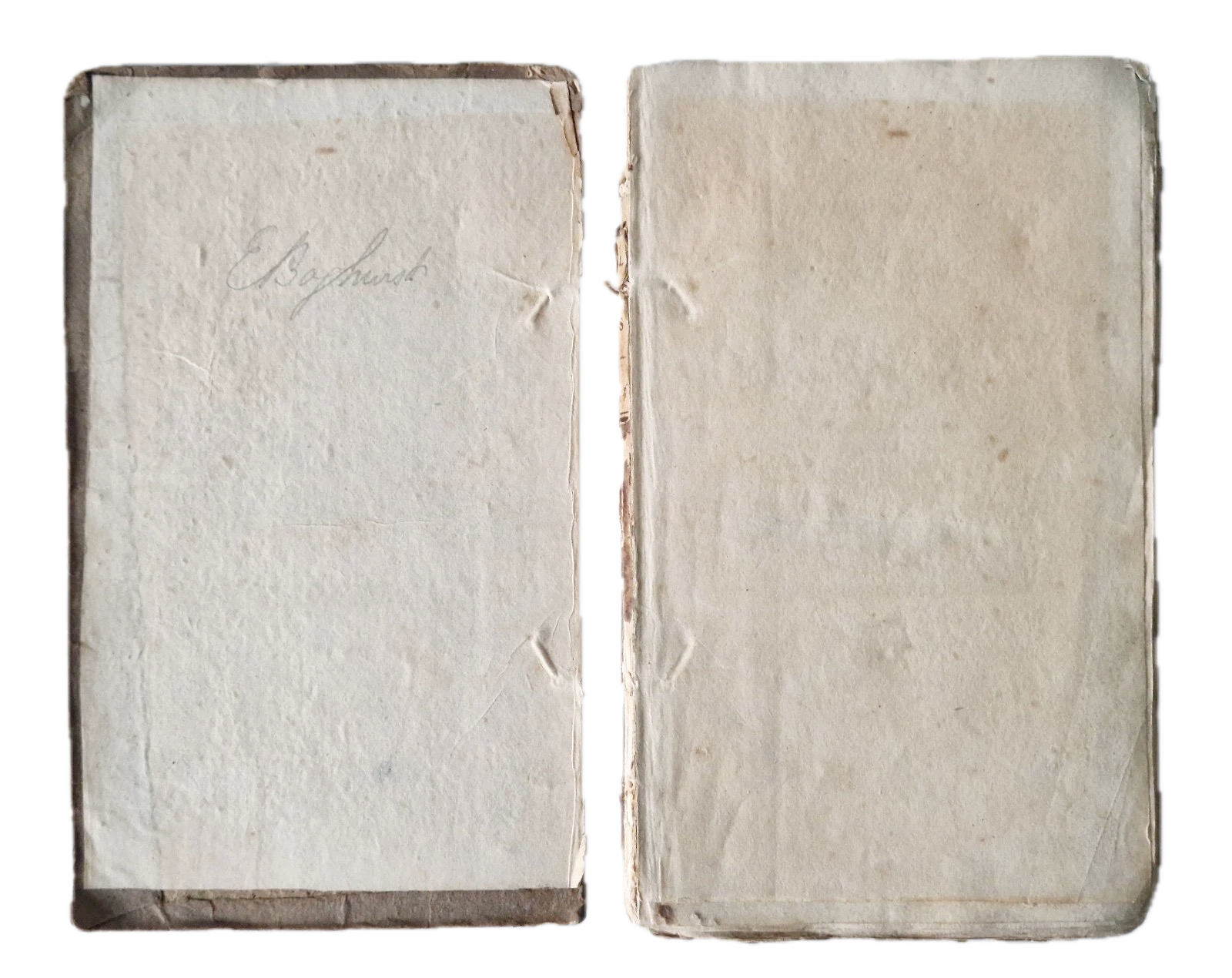
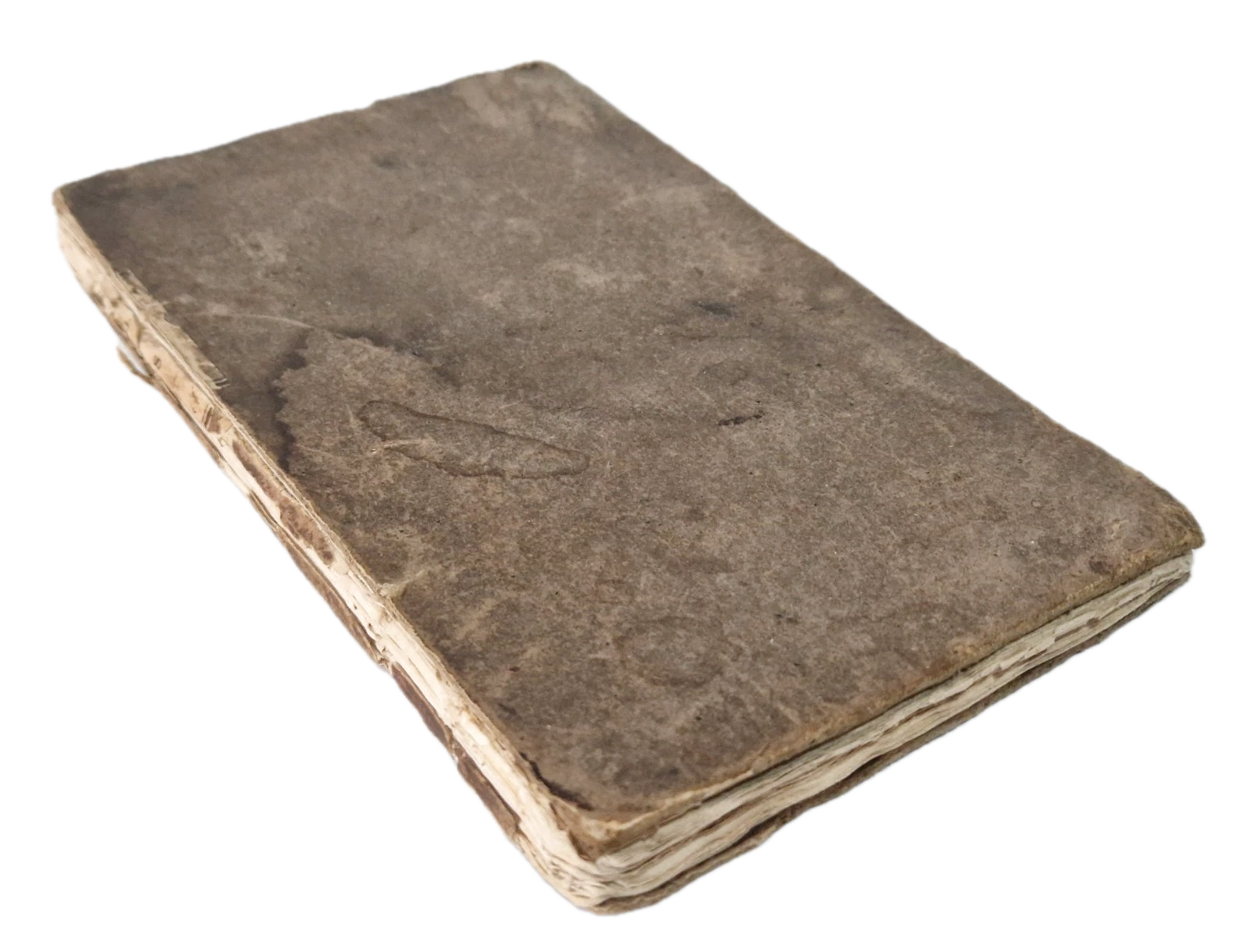
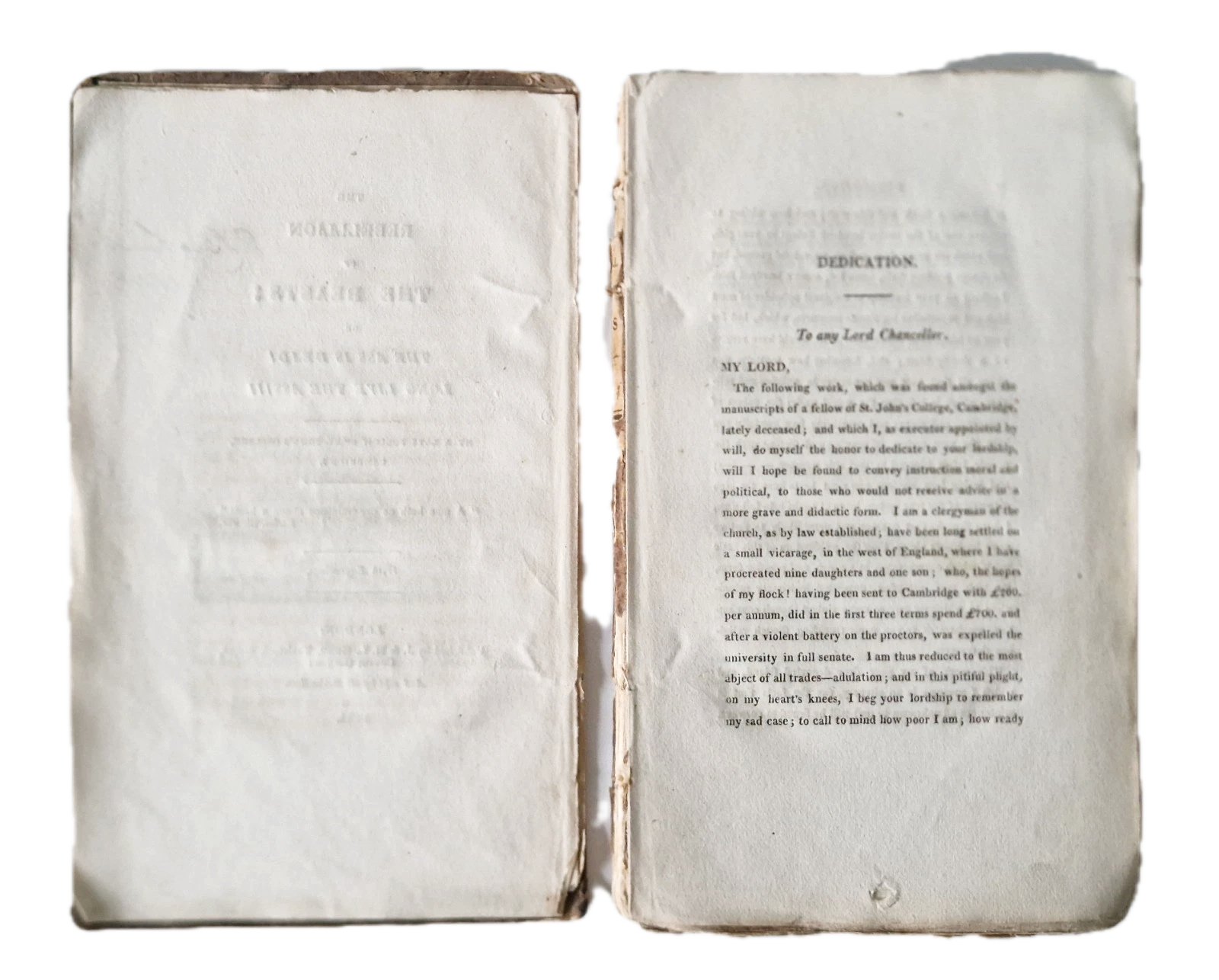
- UPDATE: I have identified the provenance (by comparing signatures) and now know that Edward Boghurst Esq. (1791-1870) was the original owner of the book. More on this anon.
OVERVIEW
Most people reading this will be very familiar with Animal Farm (1945). Many will have studied Orwell’s satirical novel at school, some will have taught it. One suspects that virtually no-one will have read The Rebellion of the Beasts. Here’s an overview:
PLOT
The Rebellion of the Beasts; or, The Ass is Dead! Long Live the Ass!!! (1825) is divided into eight sections; a lengthy dedication followed by seven chapters. The narrator, John Spratt, acquires the ability to understand animal speech and discovers that the beasts have secretly organised a revolutionary movement inspired by principles of liberty and equality. The rebellion, although bloody and violent, quickly results in a new order being established.
Victory, however, does not bring harmony. The revolutionary coalition fragments into rival factions. Some seek coexistence with mankind; others demand complete separation; still others desire revenge and domination. Ambitious leaders emerge and ideological disputes become increasingly bitter. The animals discover that political liberty does not eliminate jealousy, self-interest or the lust for power.
Out of this turmoil arises an unexpected ruler: a donkey, who eventually becomes King John the Ass (formerly Jack-ass). The revolutionary republic gives way to monarchy. The new regime constructs an elaborate mythology claiming that asses were the original rulers of the earth before the rise of humanity. A hereditary aristocracy is created, court ceremonies multiply and a powerful priesthood develops doctrines to justify royal authority. Religious institutions become instruments of political control. The priests rewrite history, invent traditions and teach unquestioning obedience. The egalitarian ideals of the rebellion are steadily replaced by hierarchy, privilege, censorship and superstition.
CHARACTERS
- John Pimlico – the fictional clergyman who writes the book’s lengthy dedication, presenting himself as a shameless seeker of patronage (satirising political and ecclesiastical sycophancy).
- John Sprat – the narrator of the story, whose discovery of a magical manuscript allows him to converse with animals and observe their revolution from within.
- John Sprat’s Father – a wealthy Norwich Quaker whose dying prophecies convince his son that he is destined for extraordinary greatness.
- Jane Sprat – John’s mother, who dreams that “all the Jack-asses of England” crown her son “Liberator of Donkeys” foreshadowing his future involvement in animal affairs.
- Mr Copper – Sprat’s learned private tutor, who educates him in classics and mathematics in preparation for Cambridge and “the literary world”.
- A Donkey – The first animal Sprat communicates with after ingesting the magical potion for forty days. Their conversation takes place at Parker’s Piece. Sprat learns of the political grievances and aspirations of the animal world. This ass will be a significant character later in the novel.
- Mrs Crumplety-Horn – an old red cow mourning the slaughter of her calf who revenges herself by goring the butcher to death. She swears early allegiance to Sprat, the “great magician”.
- A White Bull – who graphically describes his unavoidable fate (tortured for fun by humans at a “baiting” and then butchered) to the “benevolent magician”. He explains to Sprat:
“Great magician, our wrongs are beyond all endurance, and every beast and animal in the creation is in a league against man, that monster and disgrace of the works of God. We only wait for a proper day, to rise universally, and destroy our oppressors; an attempt which may be expected every day, and I assure you that very few will be spared in the grand revolution that is meditated.” - A Flea – who claims to represent all bugs whispers in the “Immortal wizard’s” ear that he will never be bitten again.
- King John the Ass (Jack-Ass) – The hereditary donkey monarch who eventually ascends the throne of the liberated animal kingdom and embodies the restoration of hierarchy after revolution.
- Queen Camilla – King John’s wife who falls into disrepute due to an affair which results in pregnancy.
- The Elephant – The king’s principal ally and supporter, representing established authority, power, and conservative interests within the new regime.
- The Bull – Chairman of the great assembly of animals on Salisbury Plain, chosen largely because his powerful voice can command immense crowds.
- The Baboon – A crafty priest and political propagandist who rises to prominence by defending monarchy and attacking reformist ideas. The Seraphic Doctor – An honorific title bestowed upon the Baboon after he becomes the chief intellectual and theological defender of the Ass’s government.
- Piggy-Wiggy – the young pig featured in the Baboon’s catechism, representing subjects indoctrinated into unquestioning loyalty and obedience.
- The Sow – the maternal instructor in the catechism who teaches Piggy-Wiggy the virtue of submission to king and state.
- Buchephalus – named after Alexander the Great’s own horse, the cream-coloured stallion from the king’s stables had the noblest blood of the best racers in the kingdom and was the head of the horse faction. He is castrated in the counter-rebellion.
- The King’s Horses – Royalists who play a major role in court intrigue and help undermine unity within the revolutionary movement.
- The Mammoth – a legendary ancestral ruler invoked by royal propagandists as part of a fabricated history designed to legitimise the donkey monarchy.
- Cornelius Agrippa – a Renaissance occult philosopher whose manuscript provides the magical method by which Sprat acquires the ability to converse with animals.
DETAILED SUMMARY
DEDICATION — To any Lord Chancellor
A clergyman named John Pimlico claims to have discovered a manuscript among the papers of a deceased Cambridge fellow – “my poor dear departed friend” – and dedicates it to any Lord Chancellor in hope of receiving an “excellent living” from the Church. He presents the book as a useful defence of established authority and publishes it chiefly to attract patronage and advance his own fortunes. In reality, the dedication is a sustained mockery of political patronage, clerical servility, anti-reform conservatism, and aristocratic privilege. Considering the Lord Chamberlain’s role in censoring politically or morally unacceptable material, it has been suggested the lengthy opening dedication was possibly “designed to dull the attention of any censor looking at the book to such an extent that only a cursory glance might be paid to the text itself” (Anderson, p. viii). Considering Hunt’s previous conflict with the authorities, it is hardly surprising he would try and throw them off the scent as well as write anonymously:
“The rage of the liberals and the radicals will be very great against this little work; and I have no doubt that it will be furiously reviewed in the Edinburgh and Westminster, to throw an odium if possible on the memory of the author, who, however, is far beyond the reach of their malice…”
Chapter I
The narrator, John Sprat, describes his Quaker upbringing (Hunt was also from a Quaker background) emphasising parental prophecies and dreams that he was destined to become an extraordinary man and one day would be crowned, “Liberator of Donkeys”. He recounts being tutored in preparation for university and a literary life. At Cambridge, he participates in a prank, raiding Magdalene College library and acquires a manuscript describing how to acquire the power of conversing with animals. After elaborate and absurdly amusing preparations – including obtaining “a doctor of divinity’s” toenail clippings and the blood of a mathematician – he performs the magical ritual and gains the coveted ability. 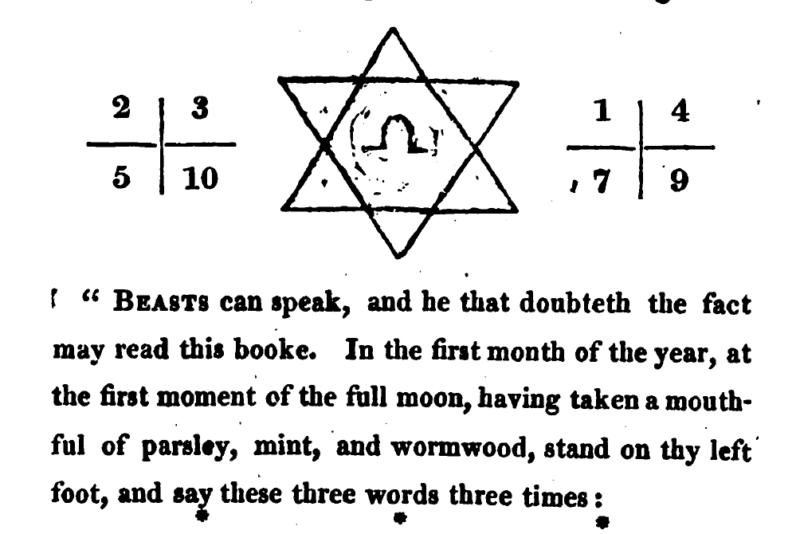
Chapter II
After forty days of vomiting each morning on drinking the magical potion, Sprat successfully speaks with a donkey who explains the hidden grievances of the animal world. He learns that beasts everywhere regard humanity as their oppressors and that “there is a grand conspiracy amongst all the beasts in the world, to liberate themselves from the tyranny of man”. Sprat, riding on the donkey’s back, meets an old red cow, the wonderfully named Mrs Crumplety-Horn. He explains to her that Sprat is destined to play a great part in their emancipation and intends to introduce him to the chief conspirators in Cambridgeshire. They join an assembly of cows, oxen, bulls, horses, dogs , sheep and donkeys who treat the narrator reverentially. The oldest Jack-ass makes a speech requesting that the “mighty magician” assists and directs their revolutionary plans. There is an electric speech by a deputy hackney-coach-horse who explains that the grand committee of the London United Brutes has summoned them to the capital for the rebellion scheduled to commence at sunrise next Monday.
Chapter III
The uprising commences and the principal conspirators meet in London on the eve of the rebellion. In a petition “To his Most Gracious Majesty, &c. &c.”, the animals of England declare that after thousands of years of patient servitude they can no longer endure humanity’s cruelty. They catalogue the many ways humans exploit and destroy them – for food, clothing, luxury, warfare, law, and entertainment – arguing that every class and political faction is complicit. Claiming that animals possessed the earth before mankind and have a natural right to freedom, they denounce human dominion as unjust usurpation. They announce their intentions to overthrow the state to recover lost liberties, urging the King to support their cause or face the consequences of their revolt. 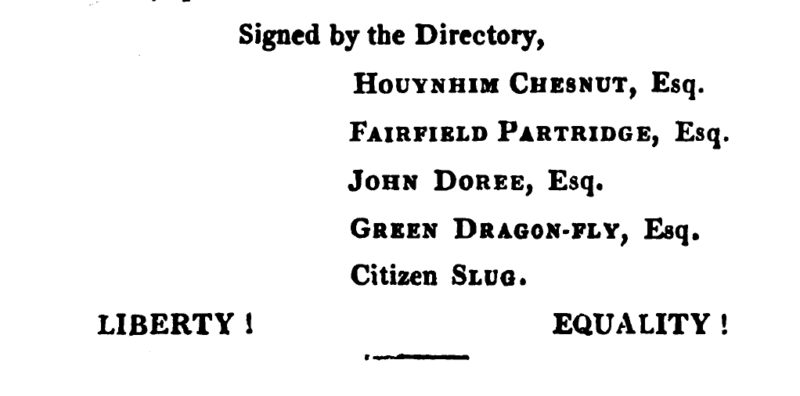
The chapter parodies both the French Revolution and contemporary fears of popular reform movements by presenting revolution through the eyes of enthusiastic beasts. In an episode that Joseph Heller, the author of Catch-22 would appreciate, government policy prevents the king from seeing the document and the petition is burnt:
After having been shewn into six antichambers, and having marched through whole regiments of powdered lacqueys, I was introduced into the secretary’s office—the gentleman who writes the minister’s answers from the king to his people. “Sir,” said I, bowing, “I have a paper of the greatest importance to deliver to the minister; who, I trust, will deliver it to the king before an hour is elapsed.” “Of what nature is the paper?” inquired the under-secretary. “It is a petition of grievances, and a demand for reform, from——”. “Oh!” said the under-secretary, “if that’s the case, I will give you an answer immediately, without troubling my lord, or his majesty either; for I dismiss such matters as these very shortly.” So saying, he briskly took a fine sheet of fools-cap hot-pressed paper, perfumed with attar of roses, on which he wrote the following answer:
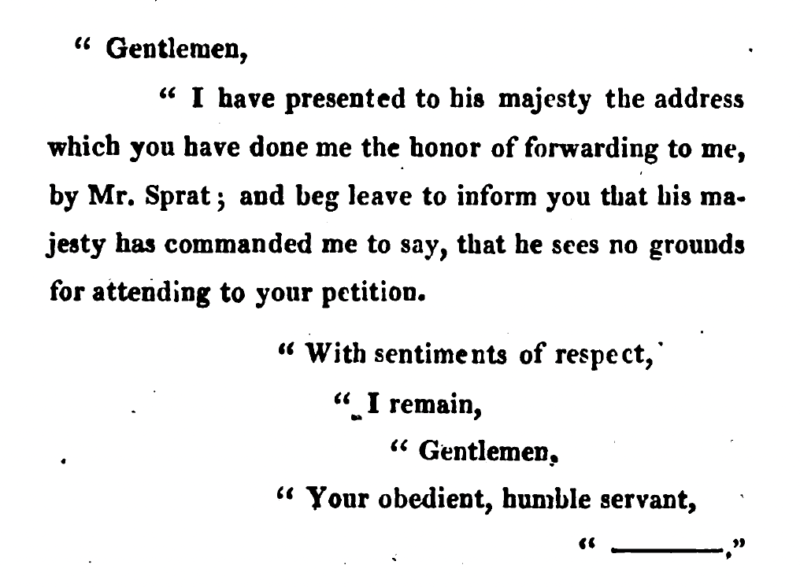
“But, my dear Sir,” exclaimed I, “do but read the petition, before you give me such an answer; the good of the whole nation depends upon the king’s taking the petition into farther consideration.” “That’s what reformers always say; and I assure you I have general orders from the minister to put all reform petitions into the fire without looking at them, nor dare I disobey orders so far as to except this from the general fate.” With this gracious answer, he handed the petition to a clerk, who handed it to a footman, who handed it into the fire…
Chapter IV
The grand rebellion of the brutes begins:
At six o’clock in the morning, the din was universal in the streets of London . All the hackney coaches were broken to pieces in the streets ; and thousands of people kicked to death by revolutionary jack-asses, and republican geldings . The people had not slept a wink all night, owing to the vigorous attacks of the fleas, bugs, and gnats ; the king had scratched himself till the blood came ; and all the peeresses in their own right had kicked and tumbled about so, on their soft feather-beds, that they were thrown into a perfect fever… Frogs and toads came crawling into every moveable, and every utensil of every manner . house was full of frogs ; his majesty found a Surinam toad bobbing about his cup of chocolate ; and a great bull-frog began croaking in the royal tea-pot : slugs and snails crept into the pockets of the lords in waiting ; the beef-eaters were stuck in the guts by rampant oxen ; and the poet-laureat was nibbled by an owl, and kicked by a donkey. All the court was in dismay ; his majesty set off full gallop to , but the horses having taken him a little way overturned the carriage, and left their gracious sovereign in the mud ! The house of commons received a sudden call ; but a great beetle flew into the speaker’s mouth, when he began to open the business of the day. The right hon. foreign secretary was stung by a hornet behind ; and a couple of earwigs crept into the ear of the chancellor of the exchequer… the lord chancellor could not speak, for he had swallowed a frog which stuck in his throat ; a baboon took possession of the throne: and a great flock of geese began a grand chorus of cackling that entirely put an end to all business. A resolution having been passed that the kingdom was in danger, and that the privy council should see that the kingdom suffered no detriment, the house was hastily broken up, and the lords and commons got off as well as they could.
The streets are strewn with bodies and detritus. There is great confusion and terror as “the order of things” is reversed. Resolutions are passed and the “Rights of Brutes” passed unanimously as the basis of relations between man and beast.
RIGHTS OF BRUTES
I. Nature has made brutes and men equal, the distinctions necessary for social order are only founded on general utility.
II. Man is a two-legged, unfledged animal, without talons, or tail.
III. No brute can be submitted to the power of man, without his consent.
IV. Without the assistance of animals, man would have remained on a perfect equality with the beasts of the forest.
V. The reason of man principally consists in his fingers, which are ten in number; for if the wrist of man had been terminated by a hoof, instead of a hand, no art or science could have been discovered, nor any knowledge gained.
VI. Brutes are, generally speaking, stronger than men.
VII. No man could live a month without the assistance of brutes:—at least the customs of society have made this intrinsically true.
LIBERTY!—FRATERNITY!—EQUALITY!
Almost immediately there is dissension amongst the conspirators about how best to conduct the rebellion. Three main parties form:
– the Ultra-Liberators, that secretly wished for the total destruction of the race of man;
– the Liberators, who wished a separate interest to be formed between man and brute, by which one should mutually assist the other;
– and the Enemies of the Rebellion, or Anti-Liberals, who were only playing the part eg. the king’s horses, who having been long used to warm stables, and plenty of corn, were mortal enemies to the new order of things that deprived them of all their luxuries .
It soon was evident that those wishing to eradicate humans were the strongest party as they were much “strengthened by several foreign brutes that had come over; amongst these were tygers, baboons, and wolves”. This chapter is a detailed parody of the worst excesses (and internal politics) of the French Revolution.
Chapter V
The revolutionary republic established after the animals overthrow mankind collapses. What begins as a movement promising “Liberty, Fraternity, Equality” degenerates into factionalism, intrigue and political violence. The great assembly of animals on Salisbury Plain becomes divided among competing groups: moderate republicans, extremists, militarists, royalists, and opportunists, each claiming to represent the true interests of the liberated beasts. The narrator observes how revolutionary principles are steadily abandoned as rival parties manoeuvre for power. The horses, who had long enjoyed privileges under the old regime, emerge as advocates of monarchy. The rats represent reactionary ultra-royalism, while other groups flirt with dictatorship and terror. Political alliances shift constantly, with yesterday’s enemies becoming today’s allies whenever expediency demands it. At the centre of these struggles stands Buchephalus, a powerful horse whose ambition increasingly threatens the fragile republic. Fear of disorder allows authoritarian measures to gain support.
The moderate animals, anxious to preserve stability, find themselves squeezed between revolutionary extremists and counter-revolutionaries. The result is a cycle familiar from many historical revolutions: liberty gives way to emergency powers, emergency powers to dictatorship, and dictatorship to monarchy. Eventually the republican experiment collapses altogether. The ass, originally one among many revolutionary figures, emerges as the candidate around whom conservatives, reactionaries, and weary moderates can unite. The lion and his allies are defeated, and the path is cleared for the restoration of hereditary kingship. Hunt’s satire here is directed not merely at monarchy but at the tendency of revolutions to reproduce the very systems of power they claim to overthrow. By the chapter’s end, the ideals of the rebellion have largely vanished, replaced by the promise of “order” under a new royal regime.
Chapter VI
The establishment of the Ass’s monarchy forms the longest and most elaborate political satire in the book. Following the dissolution of the animal parliament, King John the Ass issues a grand proclamation asserting the divine and hereditary rights of “the illustrious house of Donkeys”. He claims that before the creation of mankind the world was governed harmoniously by ancient asses and mules, whose authority has now been restored. The chapter traces the construction of a complete political and religious system designed to support royal power. A lavish coronation is held, complete with absurd ceremonial privileges, hereditary offices, and aristocratic honours. The narrator himself is rewarded with membership in the Order of Balaam’s Ass. Royal mythology expands rapidly, with King Midas elevated into a saintly ancestor and the Mammoth becoming the central figure of an official religion. The elephant-priests, led by the owl high-priest, acquire enormous influence. They reinterpret sacred texts to justify their privileges, tithes, and authority. The notorious “Book of the Mammoth” becomes a vehicle for propaganda, teaching that loyalty to king and priesthood is the highest moral duty. The celebrated “Seraphic Doctor,” a baboon theologian, publishes treatises and catechisms that inculcate obedience from infancy.
There are many pages mocking court etiquette: the king’s ears become sacred objects; courtiers compete for permission to carry or display symbolic ass’s ears. Government, religion, education, publishing, and public entertainments are all reorganised to glorify the monarchy. The chapter is essentially a sustained parody of hereditary monarchy, state religion, censorship, patronage and political orthodoxy. By its conclusion, the revolutionary hopes of the animals have been transformed into an elaborate system of royal and priestly domination.
Chapter VII
A recount of the scandal that ultimately destroys the Ass’s monarchy. Two years into the new regime, Queen Camilla is discovered to be pregnant under circumstances that cast doubt on the legitimacy of the royal succession. The king initially rejoices, believing another heir is on the way, but rumours spread throughout the court that the true father is the celebrated theologian known as the Seraphic Doctor. When the queen gives birth to twins who unmistakably bear signs of their real parentage, the deception can no longer be concealed. The king is devastated and furious. Acting from a mixture of wounded pride and political necessity, he has the infants secretly drowned and begins investigating the conspiracy surrounding the queen and the priesthood. Evidence soon reveals that the high-priest owl and other religious leaders have long known of the affair.
The scandal escalates into a struggle between crown and church. The king moves against the elephant-priests, strips them of power, and attempts to reform the kingdom. Camilla, meanwhile, becomes the rallying point for the religious party. Escaping confinement, she joins the forces of the high-priest, who elevates the dead Seraphic Doctor into a martyr and quasi-divine figure. Religious enthusiasm sweeps much of the animal population. Civil war follows. Although the Ass proves a formidable ruler and military commander, his harshness and bloodshed alienate many subjects. Ultimately his reign collapses, and later generations remember him as a paradoxical figure: energetic, courageous, and intelligent, yet fatally undone by his attachment to Camilla. The chapter satirises royal scandals, ecclesiastical intrigue, and the destructive entanglement of political power with religion, bringing the history of the animal kingdom to its turbulent conclusion.
The new monarchy allies itself with a priestly establishment. A baboon theologian and other court intellectuals produce doctrines, catechisms, and historical myths to teach unquestioning obedience to the Ass. Education becomes propaganda; loyalty becomes a civic religion. The chapter demonstrates how revolutionary ideals are transformed into a system of authority little different from the one overthrown. The animals ultimately discover that tyranny can survive even after a successful revolution, merely changing its outward form.
The tale concludes with the narrator explaining he is weary of “court anecdotes:—deaths, murders, banishments, intrigues, disgraces, and manœuvres” and trusts “a better historian” and “moralists” can reflect on what he has recorded about “the instability and fickleness of human and brutal affairs”.
PUBLICATION HISTORY
The Rebellion of the Beasts; or The Ass is Dead! Long Live the Ass!!! has a fascinating (lack of) publication history. The book was printed twice in 1825 but then an extraordinary period of time elapsed before another edition appeared nearly 180 years later, in 2004. There is some evidence to support Hunt being attributed as the author of the fable – but not all scholars are convinced. Both Thomas Wooler and Richard Porson have been suggested as possible satirists (Roe; Morrison).
The Yorkshire diarist and schoolmaster, Robert Sharp, noted in 1826 that he was gifted a “curious” book (which he had read about in the Hunts’ radical journal, The Examiner):
“I see the Rebellion of the Beasts is published. There was a notice of it in the Examiner a short time ago. They hardly know what to make of it; have you seen it? Now I have given you a fair specimen of what you may call title tattle which will at least amuse you for there is not much instruction in it.”
The literary notice he mentioned appeared on the 19th June, the same month The Rebellion of the Beasts was published.

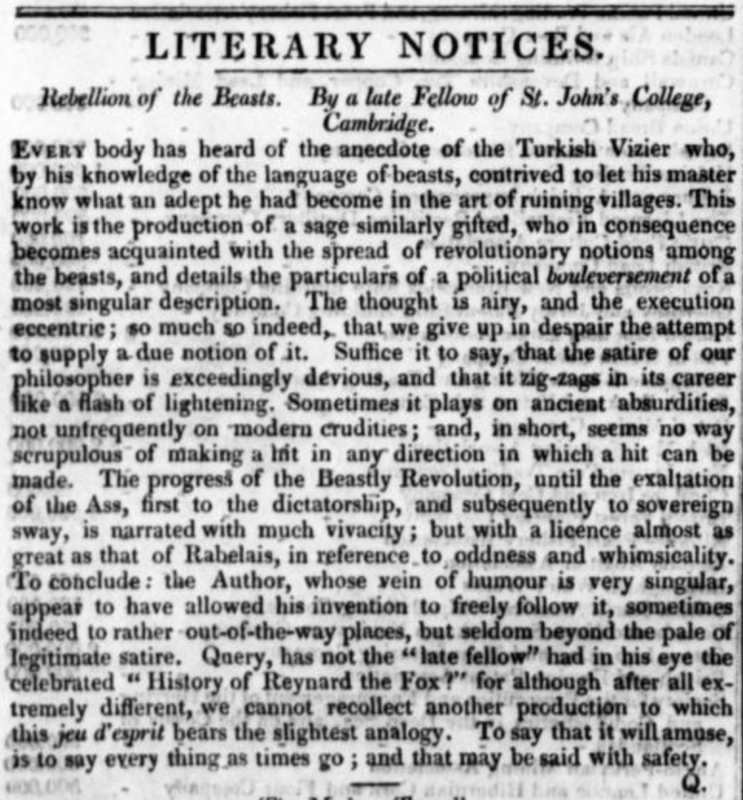
After reading the notice, one cannot help but agree with Sharp’s acute perception. “Q”, struggled to “know what to make of it” due to the originality of the work. Suggesting the “late fellow” was very conscious of the celebrated “History of Reynard the Fox” was the best the reviewer could do with fable. This led me to recall – and it is not at all significant, just interesting – that Orwell’s first published work, youthful verse written patriotically during the first months of World War One, also invoked the “wisdom of Reynard the fox”.

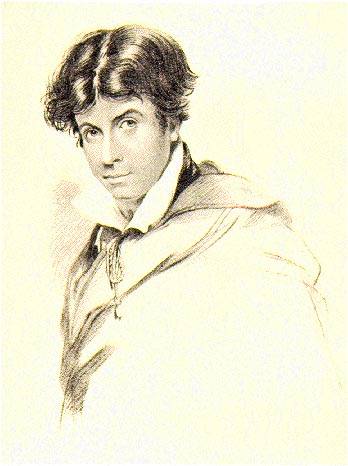
Leigh Hunt is best known for his influential role in the English Romantic movement, particularly as the friend, champion and early supporter of John Keats and Percy Bysshe Shelley. He was friends with Charles Lamb, William Hazlitt and Lord Byron. In 1808, Hunt and his brother co-founded and edited a radical weekly journal, The Examiner, which published his friends’ writing and greatly influenced radical opinion in Regency England.
The journal published writing which deliberately antagonised the monarchy and government. Between 1813-1815, in what would become a cause célèbre for reformers, intellectuals and literary figures, Leigh Hunt was incarcerated for libelling the corpulent Prince Regent as “a fat Adonis”. Hunt certainly did not languish under-employed for two years in Horsemonger Lane Gaol as he was able to continue editing the journal with his family in nearby rooms. He worked hard during his time in prison, and did his best to normalise his circumstances, famously decorating his rooms with wallpaper, bookcases, busts, pictures and a pianoforte. But he also suffered a great deal, both mentally and physically, as did members of his family. Tired and ill, when he was finally released it was evident that the last two years had taken a terrible toll. Hunt later recollected that his time in Horsemonger Lane had given him a “shock” from which he never fully recovered’ (Morrison 2019: 26). Hunt had much to lose if his allegorical novel was linked to him a decade later.
Notably the book was published by J. & H. L. Hunt of Tavistock Street in Covent Garden. John Hunt (1775-1848) was Leigh Hunt’s elder brother (and the H.L. refers to John’s son, Henry Leigh Hunt). John was a man of principle and no stranger to the consequences of libelling the crown. Gaoled several times at Coldbath Fields prison, he had been fined £100 for publishing Lord Byron’s The Vision of Judgement in the short-lived magazine, The Liberal, during October 1822. When Leigh set off for Italy in 1822, John was still in gaol. The brothers were estranged from each other from this time, mostly over financial issues (which lasted until 1840). John was still editing The Examiner in 1825 so it makes sense the novel was advertised in the pages of that weekly publication.
Orwell was always interested in radical newspapers, journals and pamphleteering. He wrote an introduction for British Pamphleteers Volume 1: From the 16th Century the 18th Century but illness prevented him from editing Volume II: From the French Revolution to the Present Time which covers Hunt and the various controversies enveloping The Examiner.

This first edition of The Rebellion of the Beasts was published anonymously with four engravings in 1825. A second edition in the same year had those same illustrations “coloured by hand”. The novel is not mentioned at all in Hunt’s published correspondence, diaries or autobiography. Nor has any of his many biographers included it in their treatments of his life and times except Barnette Miller, very briefly, in 1910:
“There is every reason to believe that it was by Hunt, although he does not mention it elsewhere. It is an exceedingly clever satire on monarchy and far surpasses anything else of the kind that he ever did. Had the Tories of Edinburgh suspected the author it would probably have made them apoplectic with rage.” (Miller, p.144)
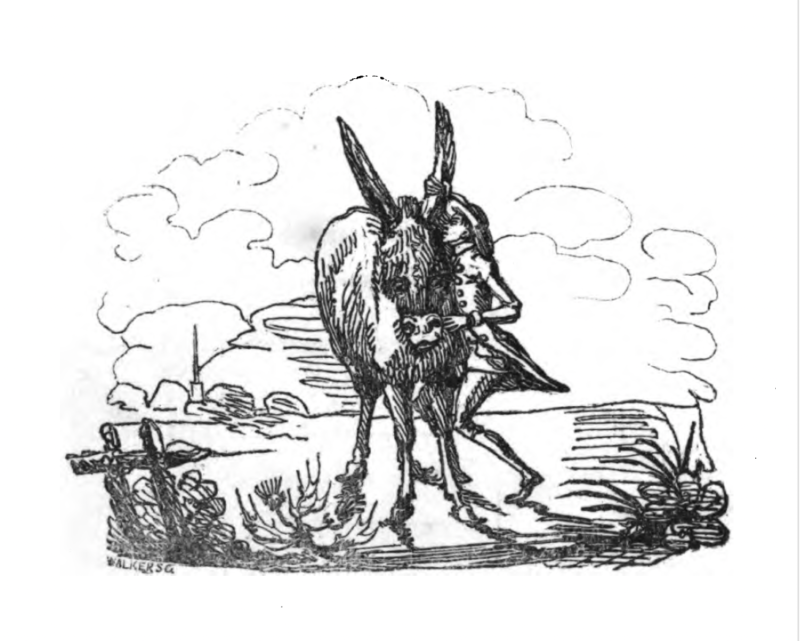
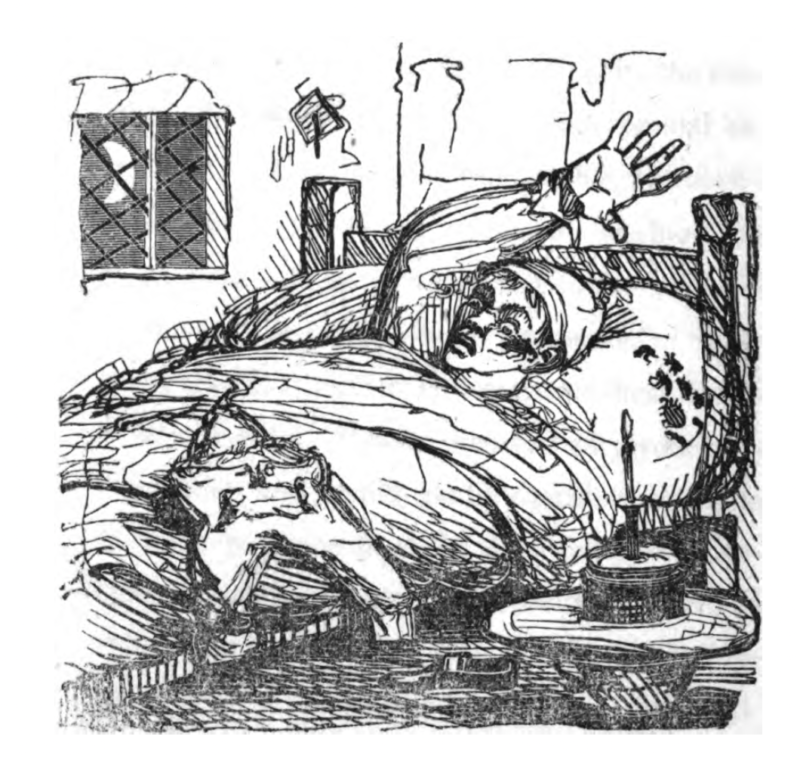
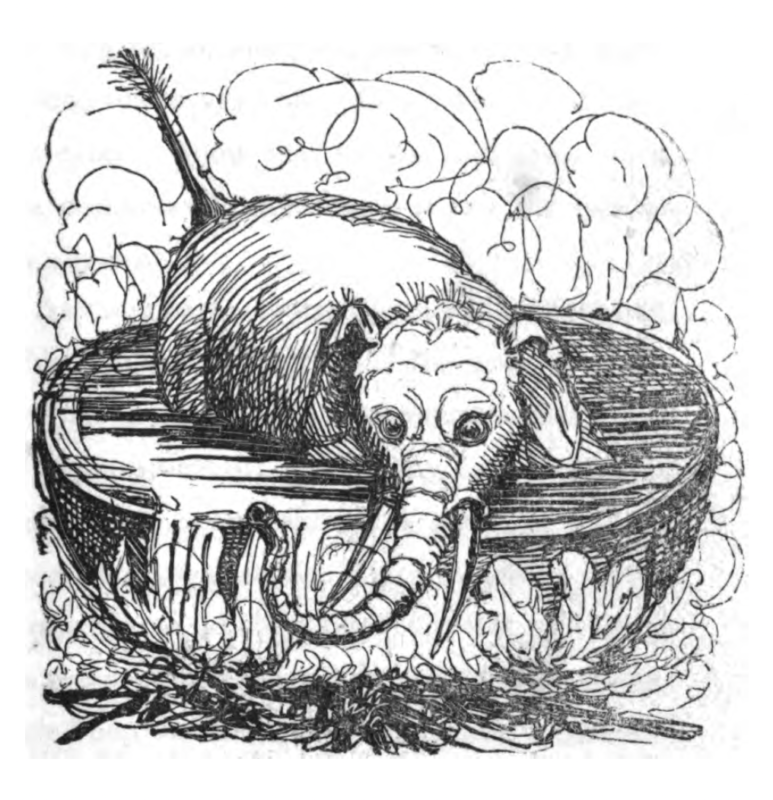
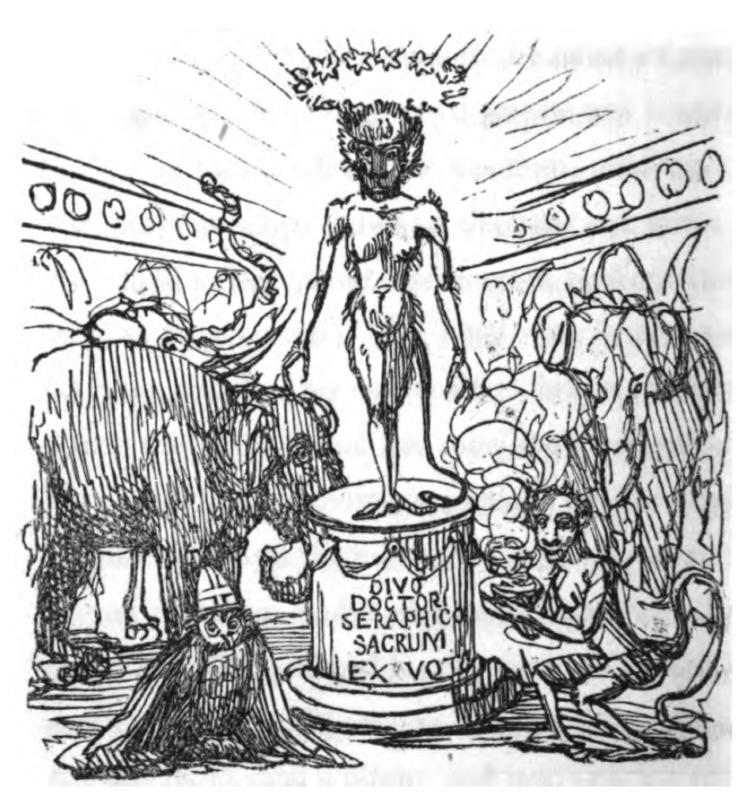
Hunt and his son were not fined or gaoled for publishing this anonymous allegory attacking the institution of monarchy for several reasons (and possibly the dedication had thrown the censor off the track):
- It was allegorical rather than directly defamatory. Previously, the Hunts had explicitly attacked the Prince Regent by name in a newspaper article. The Rebellion of the Beasts disguises its political commentary by employing allegory. This gave writers and publishers greater protection because proving a specific libel was much harder;
- It was a book, not a newspaper. Governments worried most about cheap periodicals with large and immediate circulation. A satirical novel issued in book form posed a much smaller political threat than The Examiner, which had a large readership, appeared weekly and commented directly on current affairs;
- The political climate had changed. The repression associated with the Napoleonic Wars and the immediate post-war period was easing by the mid-1820s. Although censorship and prosecutions still occurred, ministers were generally less eager to make martyrs of liberal writers than they had been in 1812–13.
If the censor had made it to the final page of the book, they would have not enjoyed the advert for Thomas Wooler’s Secret History of the Radical Era. Wooler was infamous for publishing The Black Dwarf, a radical journal established in response to the Gagging Acts passed by the British government in January 1817. 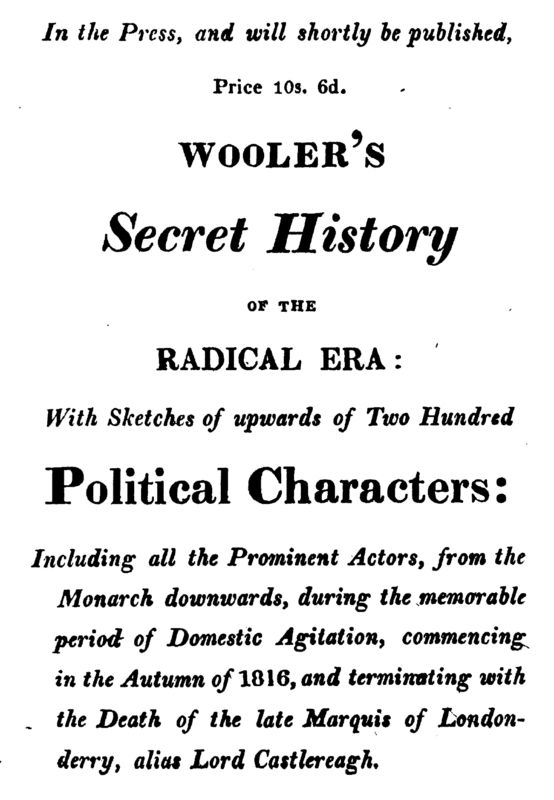
I am yet to find evidence that Wooler’s book was ever published.
The earliest reference to Leigh Hunt being the anonymous author of The Rebellion of the Beasts (discovered so far) is in The London Catalogue of Books (1831). Sotheran’s, an antiquarian bookseller still in business today, attributed Hunt as the author in their 1888 catalogue. The British Museum’s, Catalogue of Printed Books noted the title in 1894 and 1896 but questioned the attribution. 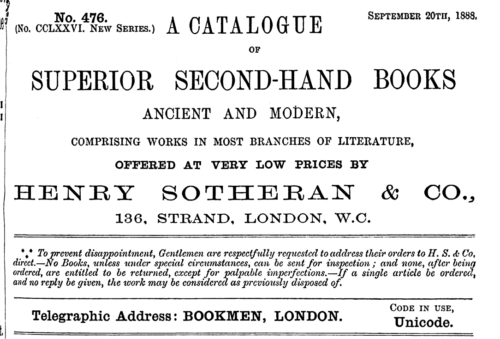
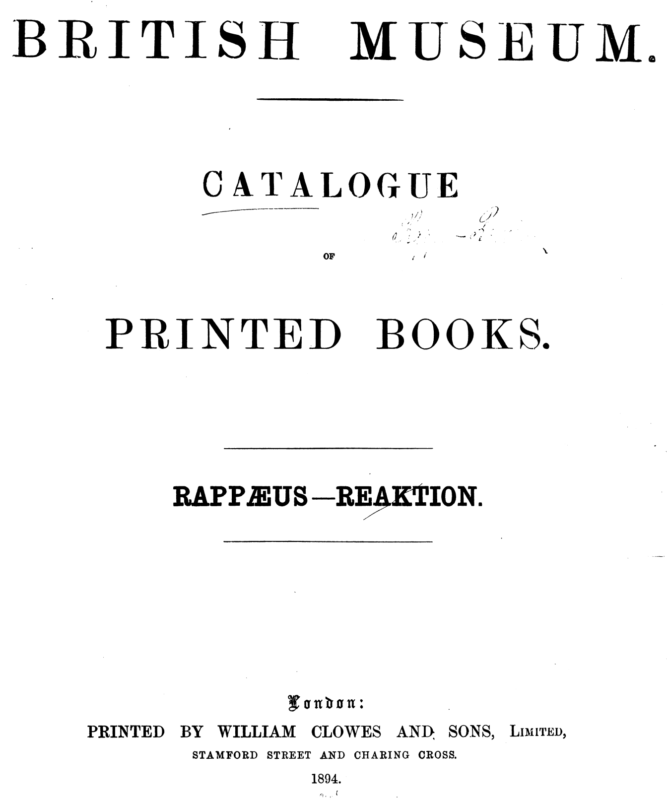
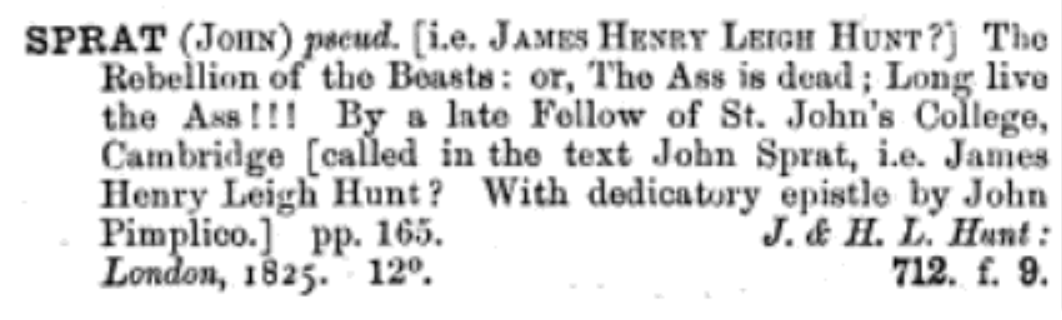
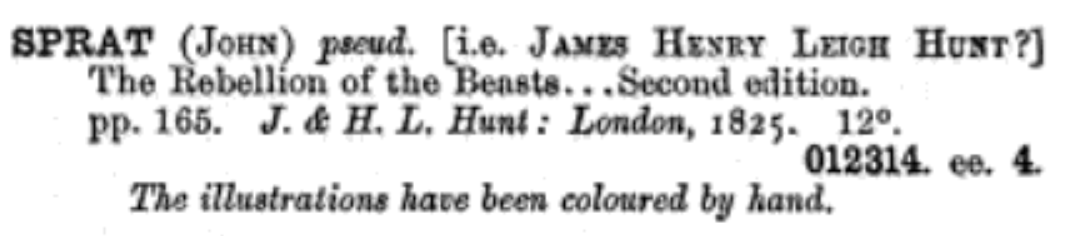
In 2004, a third edition* appeared without fanfare. This is the first time Animal Farm is mentioned in connection with fable, albeit very briefly in the introduction, where the editor admits there is no evidence that Orwell was aware of The Rebellion of the Beasts. Anderson acknowledges his very limited analysis:
“As a close comparison and analysis is beyond the scope of this introduction, I leave it for readers to draw their own conclusions.” (Anderson, p. viii)
and it appears the challenge of investigating more thoroughly has not yet happened. The only (very incidental) mention of the book in Orwell scholarship appears to be by David Wykes. His 1987 monograph, A Preface to Orwell, included it on a list of texts making “political prediction”. Hunt is not mentioned. There is no suggestion Orwell knew of the book or that Wykes believed it a precursor, model or influence on Animal Farm.
*”Entertaining as this beast fable is, it would not ordinarily be noticed here except for the kind note that accompanied it. The publisher believed “it may be of interest as the original print was used in this, the first reprinting since the original in 1825.” We puzzled over this statement for as long as two seconds: it seems to be pretty obvious that a first reprinting must use the original print. However, we had to satisfy a doubt that this edition of a quite rare book might be a type-facsimile. It isn’t. The editor has removed the long dedication to “the end of the text” — as if it were not part of the text — and omits “four crude engravings”. So this, so far as one can tell, is the third edition of the work attributed to Leigh Hunt, not a reprint.” (The Papers of the Bibliographical Society of America, p.350)
COMPARING ANIMAL FARM & THE REBELLION OF THE BEASTS
“… I saw a little boy, perhaps ten years old, driving a huge cart-horse along a narrow path, whipping it whenever it tried to turn. It struck me that if only such animals became aware of their strength we should have no power over them, and that men exploit animals in much the same way as the rich exploit the proletariat.” George Orwell
A comparison of the fables, The Rebellion of the Beasts and Animal Farm, reveal that the two works share a striking premise while differing profoundly in purpose, structure and political outlook. Although separated by 120 years, both use animal rebellion to expose the weaknesses of human political systems and to explore what happens when revolutionary ideals of equality encounter the realities of power.
The most obvious similarity is the concept of animals establishing a political order independent of human authority. In Hunt’s novel, animals articulate a theory of natural rights through the “Rights of Brutes,” a document that parodies revolutionary declarations such as the Declaration of the Rights of Man and of the Citizen. Orwell’s animals similarly adopt the “Seven Commandments” of Animalism following their rebellion against Mr Jones. In both works, the creation of a constitutional text signifies the hope that society can be reorganised on rational and egalitarian principles.
The two authors approach this idea very differently. Hunt writes in the aftermath of the French Revolution and the Napoleonic era, when debates about liberty, monarchy, and reform dominated British political culture. His novel is broad, playful and often digressive. The animal kingdom serves as a vehicle for satirising aristocratic privilege, political corruption, legal absurdities, and social inequality. Hunt’s target is not a single political system but the wider shortcomings of human governance. Orwell’s purpose, although similar, is much narrower and more precise. Animal Farm is an allegory of the Russian Revolution and the rise of Joseph Stalin. Nearly every major character and event has a historical source. Old Major combines aspects of Karl Marx and Vladimir Lenin; Napoleon represents Stalin; Snowball, Leon Trotsky; and Squealer, Pravda/the press etc.. The novella, although a general satire about the nature of revolution, is a warning about the corruption of ideals from specific revolutionary movements in the 20th century.
Another important difference lies in the treatment of political failure. Hunt recognises the difficulties of creating a just society, but he retains a measure of confidence in reform. The flaws arise from the complexity of politics itself. His satire suggests that institutions can be improved, even if perfection remains unattainable. Orwell, by contrast, presents a far darker vision. The pigs systematically exploit language, history and law to entrench their power. The transformation of the Seven Commandments culminates in the notorious declaration that “all animals are equal, but some animals are more equal than others,” a statement that exposes the complete collapse of revolutionary ideals.
The role of language is especially revealing. Hunt uses political rhetoric primarily for comic and satirical effect, parodying contemporary debates about rights and representation. Orwell treats language as an instrument of domination. Squealer’s manipulation of words anticipates the linguistic control later developed in Nineteen Eighty-Four through Newspeak and political propaganda.
Ultimately, The Rebellion of the Beasts and Animal Farm belong to the same tradition of political fable, yet they represent different moments in its evolution. Hunt, in his 165-page story, employs animals to imagine the possibilities of reform and to mock human pretensions; Orwell, in his 110-page novella, deploys farm animals to demonstrate how revolutions can betray their founding principles. The former is fundamentally a satire of politics, while the latter is a tragedy of how political idealism is corrupted.
It is important to consider the preface to the Ukrainian edition of Animal Farm (1947) where Orwell explains his motivation for writing the novella which had gestated in his mind for six years:
“And so for the past ten years I have been convinced that the destruction of the Soviet myth was essential if we wanted a revival of the Socialist movement.
On my return from Spain I thought of exposing the Soviet myth in a story that could be easily understood by almost anyone and which could be easily translated into other languages. However, the actual details of the story did not come to me for some time until one day (I was then living in a small village) I saw a little boy, perhaps ten years old, driving a huge cart-horse along a narrow path, whipping it whenever it tried to turn. It struck me that if only such animals became aware of their strength we should have no power over them, and that men exploit animals in much the same way as the rich exploit the proletariat.
I proceeded to analyse Marx’s theory from the animals’ point of view. To them it was clear that the concept of a class struggle between humans was pure illusion, since whenever it was necessary to exploit animals, all humans united against them: the true struggle is between animals and humans. From this point of departure, it was not difficult to elaborate the story. I did not write it out till 1943, for I was always engaged on other work which gave me no time; and in the end I included some events, for example the Teheran Conference, which were taking place while I was writing. Thus the main outlines of the story were in my mind over a period of six years before it was actually written.”
Did Orwell know of The Rebellion of the Beasts? We do not know! However, there’s some compelling circumstantial evidence (and somewhat trivial points) to consider:
- Orwell’s early personal reading history leaves one in no doubt he would have loved this fantastical, Swiftian satire (which is often very amusing);
- Booklovers’ Corner, where Orwell was employed as an assistant in 1934-35, provided an opportunity to browse and read an enormous number of dusty tomes. The location in Hampstead was the epicentre of “Hunt’s Circle” a century or so beforehand;
- The Seven Commandments of Animalism and Hunt’s, Rights of Brutes are the most interesting points of comparison;
- Hunt’s satire is aimed at the monarchy, political and religious establishment, effectively employing the language of the French Revolution in the text; Orwell’s allegory has the Russian Revolution as one target, using terms such as ‘comrade’ in a similar manner;
- Edmund Blunden, who researched and published widely about Hunt, was well-known to Orwell with whom he corresponded, engaged as a guest on the B.B.C. when a Talks Producer, also publishing positive reviews of his work;
- The literary notice in The Examiner suggested the “late fellow” was very conscious of the celebrated “History of Reynard the Fox” which, oddly enough, is the second line in Orwell’s first published work;
Both authors employ a wide-range range of techniques found in allegories and fables to satirise human hypocrisy and the nature of revolution. Both make use of dreams which prophesied a future where animals revolt and replace the established human order. Hunt targets monarchy, reactionary politics, aristocratic privilege, religious establishmentarianism and opposition to reform. The French Revolution and the politics of post-Napoleonic England provide his source material. Orwell attacks totalitarianism and communism by parodying the Russian Revolution and the emergence of the Soviet Union.
The most striking point of comparison is Orwell’s “The Seven Commandments” with Hunt’s “Rights of Brutes”. 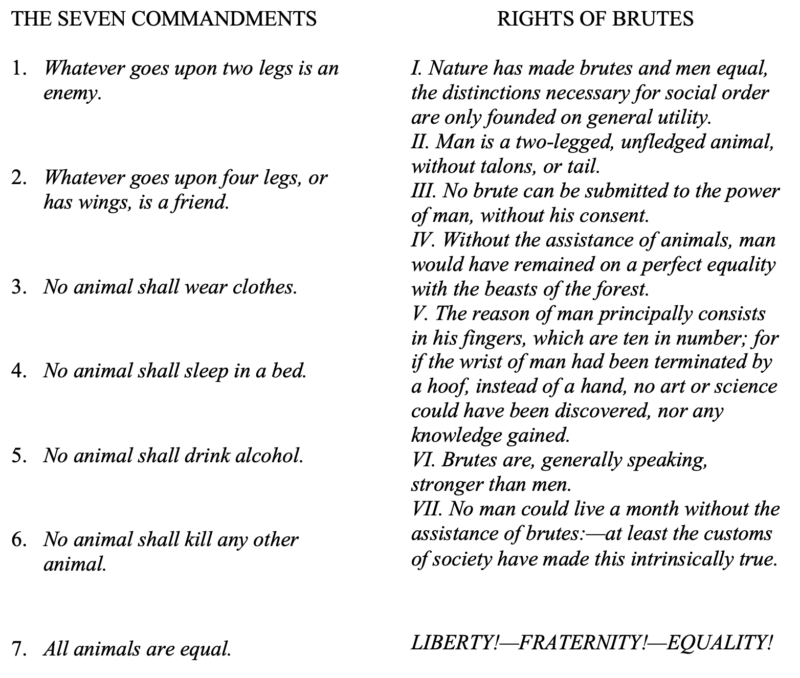
REFLECTION
“All animals are equal, but some animals are more equal than others.” George Orwell
There is no hard proof that George Orwell was aware of The Rebellion of the Beasts; or The Ass is Dead! Long Live the Ass!!!. Who knows where an author pulls his ideas from in the creative process of writing a novel. Ansell Adams believed that “all the pictures you have seen, the books you have read, the music you have heard, the people you have loved” were employed in the process of making a photo! Any close study of Orwell’s novels, with this philosophy in mind, bears fruit.
However, can one really believe Orwell was completely unaware of The Rebellion of the Beasts? Similarly, surely Orwell had read The Missing Muse & Other Essays (1928). This book by Philip Guedalla (1899-1944) has the following line reminiscent of his famous epithet, “All animals are equal, but some animals are more equal than others”:
“The Moujik, unable to repress a distant memory of the feudal system, bowed profoundly. This appeared to gratify the Good Fairy, who believed that all fairies were equal before the law, but held strongly that some fairies were more equal than others. But at that instant the Moujik, recollecting his principles, called the Good Fairy a number of bad names…”.
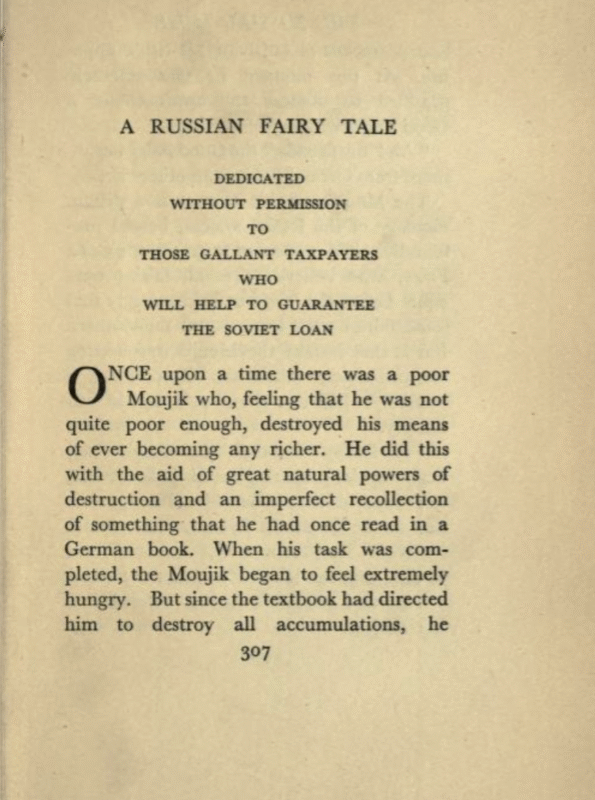
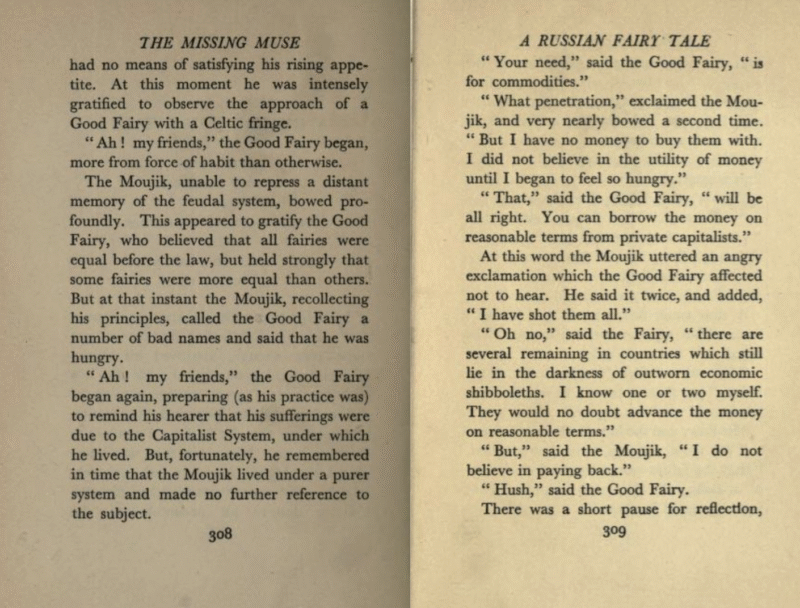
For my mind, Orwell very possibly discovered both texts when he worked at Booklovers’ Corner in the 1930s. Even if he did know both, he has neither plagiarised nor appropriated either text. Orwell did not write Animal Farm after reading The Rebellion of the Beasts or The Missing Muse. However, both texts, fascinating in their own right, are worthy of further consideration by scholars and general readers of Orwell’s work.
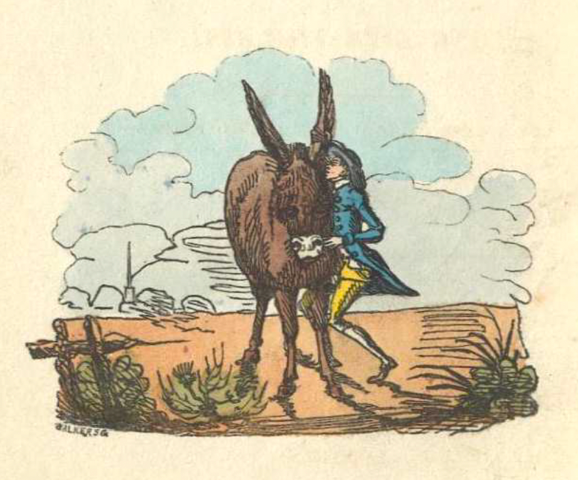
FEATURED IMAGE: Colourised engraving from the second edition of The Rebellion of the Beasts; or, The Ass is Dead! Long Live the Ass!!!
REFERENCES
Anonymous, The Rebellion of the Beasts; or, The Ass is Dead! Long Live the Ass!!!, London: J.&H.L. Hunt, 1825
Anonymous, The Rebellion of the Beasts; or, The Ass is Dead! Long Live the Ass!!!, London: J.&H.L. Hunt, 1825 (second edition)
Bateson, Frederick Wilse, The Cambridge Bibliography of English literature Volume III: 1800-1900, Cambridge University Press, 1940
Blainey, Ann, Immortal Boy: A Portrait of Leigh Hunt, London, Routledge & Kegan Paul, 1985
Blunden, Edmund, Leigh Hunt: A Biography, London, Cobden-Sanderson, 1930.
British Museum, Catalogue of Printed Books London: William Clowes and Sons, 1894
British Museum, Catalogue of Printed Books: Volume 74, London: William Clowes and Sons, 1896
Clarke, I F., British Future Fiction, 1700-1914, Volume 1, Taylor & Francis, 2017
Guedalla, Philip, The Missing Muse & Other Essays, London: Hodder & Staughton, 1928
Hunt, Leigh. The Rebellion of the Beasts; or, The Ass is Dead! Long Live the Ass!!!, edited and introduced by Douglas A. Anderson, Chicago: Wicker Park Press, 2004
Hunt, Leigh, The Autobiography of Leigh Hunt, edited by Roger Ingpen, 2 vols., London, Methuen, 1903
Hunt, Leigh, The Autobiography of Leigh Hunt, edited by J. E. Morpurgo, London: Cresset Press, 1948.
Holden, Anthony, The Wit in the Dungeon: The Remarkable Life of Leigh Hunt, London: Little, Brown, 2005
Johnson, R. Brimley, Leigh Hunt, London: Walter Scott Publishing Co., 1896
McCrimmon, Barbara, Power, Politics, and Print: The Publication of the British Museum Catalogue, 1881-1900, London: Linnet Books, 1981
Miller, Barnette, Leigh Hunt’s Relations with Byron, Shelley and Keats, New York: Columbia University Press, 1910
Monkhouse, Cosmo, Leigh Hunt, London: Walter Scott Publishing Co., 1893
Morrison, Robert (ed), The Selected Writings of Leigh Hunt, Volume 3, London: Pickering and Chatto, 2003
Morrison, Robert, The Regency Revolution: Jane Austen, Napoleon, Lord Byron and the Making of the Modern World, Atlantic Books (Kindle edition), 2019
Orwell, George, Animal Farm: A Fairy Story, London: Secker & Warburg, 1945
Orwell, George, All Propaganda Is Lies, The Complete Works of George Orwell, Vol. XIII, Davison, Peter (ed.) London: Secker & Warburg, (1998 [1941-1942])
Orwell, George, Keeping Our Little Corner Clean, The Complete Works of George Orwell, Vol. XIV, Davison, Peter (ed.) London: Secker & Warburg, (1998 [1942-1943])
Orwell, George, Two Wasted Years, The Complete Works of George Orwell, Vol. XV, Davison, Peter (ed.) London: Secker & Warburg, (1998 [1943])
Orwell, George, I Have Tried to Tell the Truth: The Complete Works of George Orwell, Vol. XVI, Davison, Peter (ed.) London: Secker & Warburg, (1998 [1943-1944])
Orwell, George, It Is What I Think: 1947–1948, The Complete Works of George Orwell – Vol. XIX, Davison, Peter (ed.) London: Secker & Warburg, (1998 [1947-1948])
Orwell, George and Reynolds, Reginald, British Pamphleteers Volume 1: From the 16th Century the 18th Century, London: Allan Wingate, 1948
Taylor, A.J.P. and Reynolds, Reginald, British Pamphleteers Volume II: From the French Revolution to the Present Time, London: Allan Wingate, 1951
Roe, Nicholas, “Hunt, (James Henry) Leigh (1784–1859), poet, journalist, and literary critic.” Oxford Dictionary of National Biography. 23 Sep. 2004
Roe, Nicholas, Fiery Heart: The First Life of Leigh Hunt, London: Pimlico, 2005
Roe, Nicholas, “The Rebellion of the Beasts: Or, The Ass Is Dead! Long Live the Ass!!!, by Leigh Hunt and Douglas A. Anderson”, The Wordsworth Circle, 35, no. 4 (2004): 191–93
Sharp, Robert et al, The Diary of Robert Sharp of South Cave: Life in a Yorkshire Village 1812-1837, Oxford: Oxford University Press for the British Academy, 1997
Sotheran, Henry, A Catalogue of Superior Second-Hand Books, No. 476, 20 September 1888, Henry Sotheran & Company, 1888
Unsigned, “Literary Notices.—Rebellion of the Beasts, By a Late Fellow of St. John’s College, Cambridge”, The Examiner, No. 907, 19 June 1825
Unsigned, “The Rebellion of the Beasts, or, The Ass Is Dead! Long Live the Ass!!!, by Leigh Hunt and Douglas A. Anderson”, The Papers of the Bibliographical Society of America, 2005, vol. 99, no. 2: 350–350
Webb, Timothy, “Hunt, John (1775–1848), printer and publisher.” Oxford Dictionary of National Biography, 23 Sep. 2004
Wu, Duncan, William Hazlitt: The First Modern Man, Oxford University Press, 2008

Discover more from Darcy Moore
Subscribe to get the latest posts sent to your email.
Douglas Kerr
He mentions Leigh Hunt’s “Jenny Kissed Me” in a list of “good bad poems” in English, though it is the sort of thing he could easily have found in an anthology (it’s in Palgrave’s Golden Treasury), or in a school poetry book. No other mentions of Leigh Hunt, I think. (see CWGO XIII: 158)
Darcy Moore
Thanks Douglas. Yes, I scoured CWGO and the most interesting connection to Hunt, albeit peripheral, was Edmund Blunden.