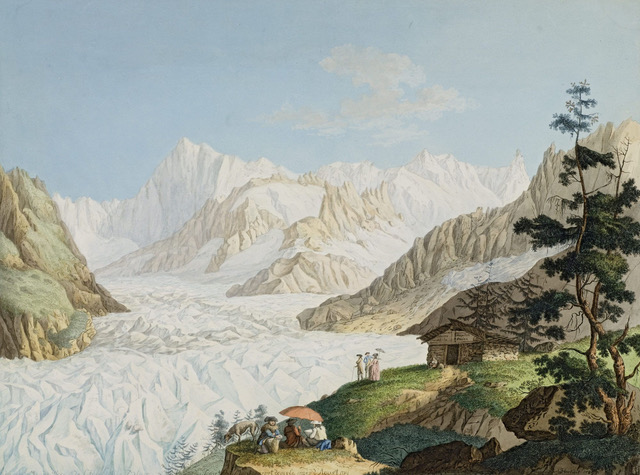
“On the spot where we were standing is a small cabin, built of stones loosely piled together, as a shelter for travellers, which in joke has been named “The Castle of Mont Anvert.” An Englishman of the name of Blaire, who is residing at Geneva, has caused a more spacious one to be built at a more convenient spot, and a little higher up, where, sitting by a fireside, you catch through the window a view of the whole ice-valley.”
…………………………………………… . Johann Wolfgang von Goethe (5 Nov, 1779)
“Hear my tale; it is long and strange, and the temperature of this place is not fitting to your fine sensations; come to the hut upon the mountain. The sun is yet high in the heavens; before it descends to hide itself behind yon snowy precipices, and illuminate another world, you will have heard my story, and can decide…”
……………………………………………………………………… … ……. .. …….Frankenstein (1818)
In the summer of 1784, George Orwell’s great-great-grandparents invited Horace Bénédict de Saussure to tea. The Genevan geologist, meteorologist, inventor, mountaineer and botanist was very familiar with the “little hut” or “small cabin” which greeted the steady stream of poets, artists, diplomats, botanists, mountaineers, tourists and aristocratic travellers who ascended from the village of Chamouny to view the fabled, Mont Blanc. Charles Blair – who had paid “four guineas” to have this shelter constructed from the readily available granite and timber – would be “immortalised” by those who made the two-and-a-half hour pilgrimage to experience the sublime view.
Orwell’s ancestors, Charles Blair (1743-1802) and Lady Mary Blair (1741-1813) had resided with their children on and off at Château de Penthes, overlooking Lake Geneva, since late 1778. Although the hut has long been associated with leading figures in the Romantic movement and written about extensively in scholarly publications, traveller magazines, mountaineering journals and websites, no-one has previously connected this “Blaire” to his famous descendant, Eric Blair, more commonly known by the pseudonym, George Orwell, the author of Nineteen Eighty-Four and Animal Farm.
Blair and his aristocratic wife, the daughter of the Earl of Westmorland, would have had much to discuss with Saussure. The Blairs were enthusiastically collecting a variety of natural specimens to post back to the author of the first English language biography of Carl Linnaeus, their own physician, Richard Pulteney, who resided in Blandford, Dorset:
“Pulteney is remembered as a zealous promoter of the methods and nomenclature of Linnaeus and as a historian of botany in Britain. His benevolence, integrity, and tolerance endeared him to his contemporaries. His papers, preserved in the archives of the Linnean Society library, incorporate a lifetime’s correspondence with most of the eminent botanists and physicians of his day and provide an important and fascinating commentary on the history of natural science in the latter half of the eighteenth century.” ODNB
Pulteney was deeply committed to promoting Linnaean taxonomy and correspondence between he and Lady Mary covered a range of issues and challenges. He responded professionally to her concerns about a son’s worrisome health and her husband’s severe gout. Pulteney passed on messages requesting financial support for former Blair servants who were ill and politely suggested patronage for various intellectual and scientific pursuits requiring funds.
In one exchange from 1780, it becomes evident that Lady Mary has posted “two prints of Haller” to Pulteney. Albrecht von Haller, who had died in late 1777, was an important Swiss botanist who Saussure had collected plant specimens for in the Chamonix Valley since 1760. The several hundred surviving letters from the correspondence between Haller and Saussure document their considerable shared intellectual pursuits.
There would have been much to discuss over tea.


In the same year another British resident of Geneva, Reverend Thomas Brand, the future Chancellor of Lincoln Cathedral, had wittily expressed insight into Blair’s motivations for building the famed shelter (and a possible cause of his terrible gout):
“… a little hut which Mr. Blair, an English gentleman, whose claret hounds and fortune had run so fast in Dorsetshire that he himself was obliged to quit England, had built as a shelter against a storm or to preserve his wine from the sun on his frequent excursions to Chamouny. This is dignified with the inscription Château Blair. The paysans call it the Chateau de Montanvert, and sometimes the Château de folie.”
There has always been conjecture about exactly when Blair built the structure which was to garner such fame with Alpine travellers. Some travellers confused the names. Thomas Blaikie, a renowned Scottish botanist and garden designer, mentions it being in situ c. 1775-1776. However, it appears he had misremembered the year. There are other dates as early as 1770 but Saussure, whose great-grandson was the linguist and semiotician, Ferdinand de Saussure, wrote about what he saw during an expedition in 1778. He described how a great block of granite, deposited by some ancient geological upheaval was at an acute angle with the ground creating an empty space beneath it. He thought that an unknown but clearly industrious Chamouniard shepherd had created a “castle” by protecting himself from driving winds with a wall of dry stones. Saussure had himself slept there before Blair’s structure was erected. As early as the 1740s, British visitors described this much more simply as “a great boulder” they would lunch besides or sleep under.
It is evident that “Chateau de Montanvert” and “Château de folie” were incorrectly assigned names for Blair’s hut from some tourists. These were the pre-existing names for basic rock shelter arranged by shepherds rather than the Englishman’s new four guinea investment.
The exact chronology of the Blairs’ lives in Europe is challenging. However, it seems very likely the Blairs travelled to Geneva after reading “A short account of a journey to the Glacieres, in Savoy” which was “Written in form of a Letter to Lady Mary Blair” and published at Bath in 1778 by J.B. Weber. The author’s account was based on his exploration in the previous year. His party departed Geneva in late July 1777 and the following description suggests that Lady Mary had not previously visited the area:
“It would be impossible to give your ladyship a complete idea of this immense and majestic mountain . The crust of ice that covers it almost from its foot, in the valley of Chamougny, to its summit, resembles, in some places, a tempestuous sea ; in others, one should think of feeing the ruins of towers and castles entrecoup with deep chasms , in other places the mountain advances itself on the borders of some pointed rocks.”
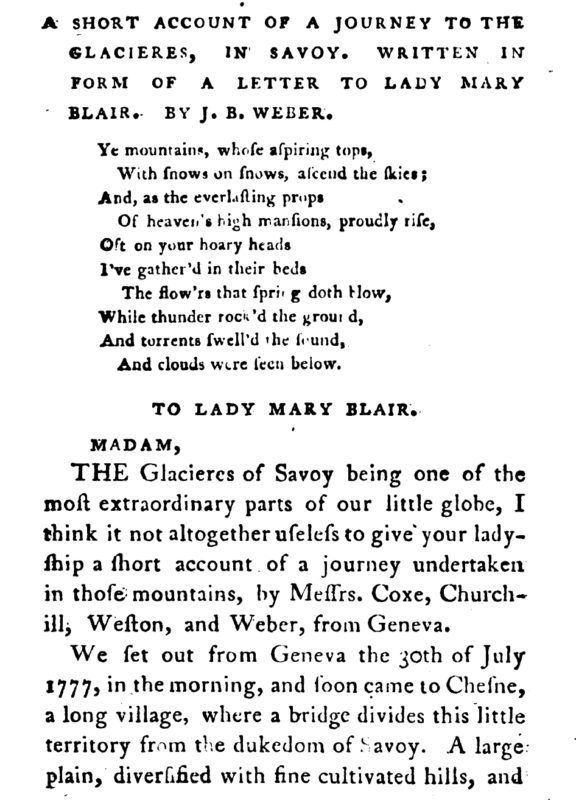
Weber continues on saying it “is obvious to every person conversant in natural philosophy” indicating Lady Mary is such a person. He also describes the basic shelter local shepherd’s had constructed:
“Our guides, perceiving us desirous of reaching the top, told us we should soon come to the Chateau de Montanvert, which, on our arrival, we found to be a shepherd’s cavern , made with large stones. The entrance into it was so low that it was with difficulty we crept in one after another. The fight of the stupendous ice valley, as seen from the top of this mountain , filled our minds with such admiration…”
It is possible Weber called on Reverend Thomas Brand, who was residing in Geneva at this time:
“We met here with Mr. Bourrit* (who has published a description of the Glacieres ) and two clergymen from Geneva, of my acquaintance, with whom we went up the Montanvert.”
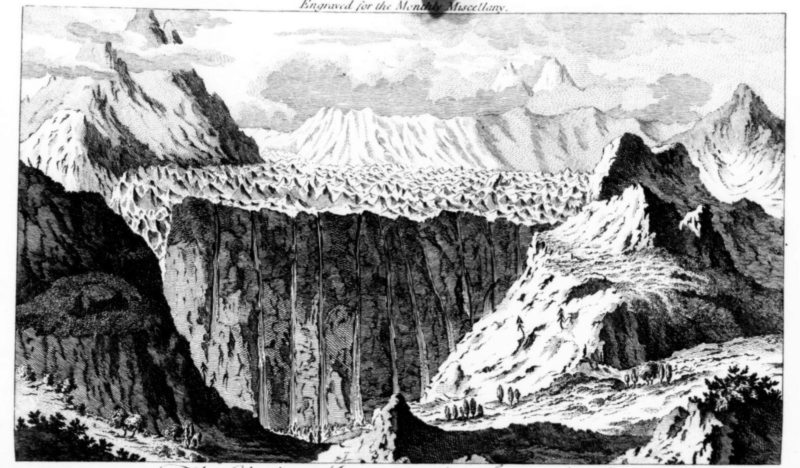
The opening lines of poetry quoted by Weber are by William Benson Earle, a fellow of the Royal Society, who had written anonymously in The Monthly Miscellany (1775) about his own expedition in 1767 which included “a beautiful engraving”.
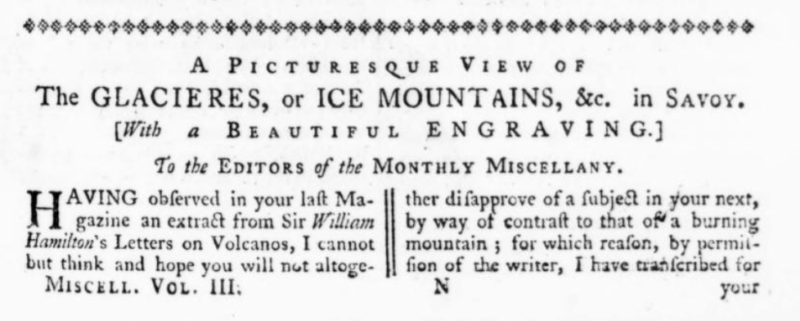
Considering the Blair family settled in Geneva during 1778 and Goethe’s letter (quoted above), it seems reasonable to assume Blair’s hut had been erected by 1779. If one was thinking charitably, perhaps it was more about “natural philosophy” than Charles Blair’s wine or being “obliged to quit England” as Reverend Brand insinuates.
The two, of course, are not mutually exclusive.
VISUAL & OTHER REPRESENTATIONS OF BLAIR’S HUT
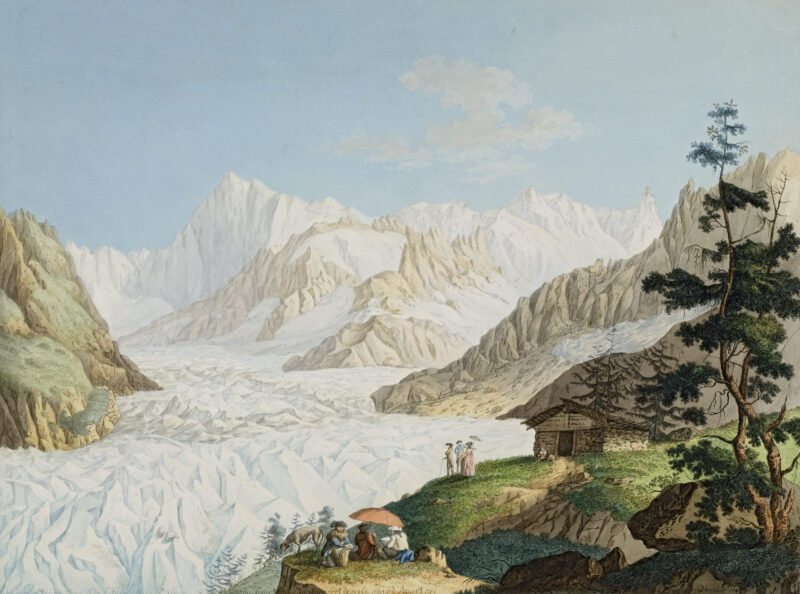
The history gleaned from a surprising number of traveller’s diaries and letters about the structures on Montavert is complimented visually by significant British, German and Swiss artists. Carl Ludwig Hackert (1740-1796), the German landscape painter and etcher created an invaluable record of Blair’s hut in his painting, Vue de la Mer de Glace et de l’Hôpital de Blair du sommet du Montanvert. This landscape confirms that l’Hôpital de Blair was a well-established destination for travellers by 1781.
The latin motto above the door – Utile dulci – is worthy of reflection. Much of the analysis refers to the Roman poet Horace and how the platitude, taken from Ars Poetica, evokes the notions that l’Hôpital de Blair provided a mixture of the “useful” and the “sweet”. There are subtle variations in the translation and interpretation related to the success one has from mixing pleasure and profit but there is little doubt the procession of poets and artists who passed under the inscription would have enjoyed the literariness of the reference.
Although most travellers appreciated Blair’s investment, Marc-Théodore Bourrit, who guided J.B. Weber* in 1777 and unsuccessfully attempted to climb Mont Blanc in 1784-1785, wrote scathingly.
“Cette route, qu’il faut faire à pied, sera toujours pour bien des personnes, un obstacle à la jouissance de la vallée de glace, surtout pour les femmes, par la fatigue et la sueur qu’elle fait éprouver. Il serait cependant facile de l’améliorer, d’en écarter les embarras, et de faire qu’un mulet pût parvenir au sommet. J’aurais vu avec plaisir, que le voyageur qui a donné quatre guinées pour bâtir sur ce mont une hutte assez inutile, les eût donnés pour la réparation du chemin. Il est vrai que le bétail qui pâture pendant quelques semaines sur la montagne, se retire dans cette cabane à l’abri des orages.”
“This route, which must be made on foot, will always be an obstacle for many people to the enjoyment of the Valley of Ice, especially for women, because of the fatigue and perspiration it occasions. Yet it would be easy to improve it, to remove its difficulties, and to make it possible for a mule to reach the summit. I should have been pleased had the traveller who gave four guineas to build upon this mountain a rather useless hut given them instead for the repair of the path. It is true that the cattle which graze on the mountain for a few weeks take refuge in this hut from the storms.”
Blair’s hut became a famous landmark for the growing number of visitors. Mary Berry, a British traveller recorded in her diary entry for Thursday 1st July 1784 how graffiti was a feature of the experience for travellers who stopped at what was variously known as Refuge de Blair, Hospice de Blair, Cabane de Blair or Château de Blair:
“Set out early for the Montanvert, with Victor and Paschard as our guides, and nearly a dozen children following us with milk and strawberries to sell at the top. We arrived at the little hovel called Blair’s Hospital, where we refreshed ourselves with our provisions. This little place, though situated on the summit of that part of the mountain from which one descends to the great Mer de Glace, is covered with rhododendrons, and there is very good pasturage for cattle brought up there in summer. From there we made a steep descent to the moraine of the Mer de Glace. It has been justly called a sea, for it has exactly the appearance of a violently agitated ocean suddenly arrested. When one is upon it, the waves (if one may call them so) are like little mountains over whose tops one cannot see, and one walks in valleys and along the sides of these hills of ice. We returned to Blair’s Hospital, where we again rested before our descent. The rafters of this little hovel, though it has only been erected seven or eight years, are so covered with English and French names and verses that one can hardly distinguish one from another.”
In 1793, Bourrit was hired as mountain guide by Charles Louis Huguet, 1st Marquis of Sémonville, the newly minted French Ambassador to Turkey. He proposed building a more adequate shelter, leaving the imperfect one that “Lord Blair” had organised in situ. The ambassador never assumed his political appointment as he was captured by the Austrians during the War of the First Coalition but funds were forthcoming from Félix Desportes – a disciple of Jean-Jacques Rousseau and protégé of Danton – who fled to Geneva after the Reign of Terror. The story was enshrined in one very popular travel guide:
“Until within a few years, the path beyond this place was impracticable for mules; now, however, it is made good to the pavilion, or house, on the Montanvert, which is reached from Chamouny in 2½ hours. This was originally a rough inclosure of four dry walls, covered with a roof for shelter, which was built at the expense of an Englishman, and named the Château de Blair; this has now become a cowhouse or stable; and even the pavilion, built afterwards at the expense of a M. Desportes, by M. Jaquet, to extend the benefits of the Château de Blair, is so improved, that refreshment, accommodation, and beds, in the season, await the visitors to the Montanvert, the Jardin, and other spots of interest to which it leads.”

From 1795, the new structure proposed by Huguet, funded by Desportes and built by the Genovese architect Jean Jaquet – completed in just three months under the guidance of Bourrit – had become a reality.

The new octagonal pavilion, with the inscription “A La Nature”, would be celebrated, graffitied, documented, painted and slept-in by a who’s who of artists, writers, intellectuals and grandees. It inspired a great deal of literary and artistic endeavour and almost immediately became emblematic of the Romantic movement and Alpine tourism. The guestbook and graffiti in several languages provided an incredible record of who visited, complementing more formal texts.
A painting by Jean-Antoine Linck (1766-1843), Vue de la Mer de glace, des Aiguilles des Charmos, du Géant de la grande Forasse et des Hospices du Sommet du Montanvert, shows the relative locations of the structures Blair and Bourrit championed.

There are more scholarly treatises, references and representations of le Temple de la Nature than one can imagine or even sensibly list. The condition, changes and longevity of both structures has been much discussed. It appears that Château de Blair had completely crumbled into ruins by the 1840s (possibly earlier) but contemporary visitors can still see some evidence of where it stood today (McKeating 2020). Even though further tourist infrastructure developed, the Temple of Nature may still enjoyed by contemporary tourists.
It is worth noting that the English Romantic painter J.M.W. Turner visited in 1802 and produced a very different perspective than most of Château de Blair. Turner climbed down onto the glacier to make his initial drawings for what would become Blair’s Hut on the Montenvers. The hut can be glimpsed distantly to the left on the pine-clad slopes

BLAIR’S HUT, FRANKENSTEIN & HORACE DE SAUSSURE
“It was nearly noon when I arrived at the top of the ascent. For some time I sat upon the rock that overlooks the sea of ice. A mist covered both that and the surrounding mountains. Presently a breeze dissipated the cloud, and I descended upon the glacier. The surface is very uneven, rising like the waves of a troubled sea, descending low, and interspersed by rifts that sink deep. The field of ice is almost a league in width, but I spent nearly two hours in crossing it. The opposite mountain is a bare perpendicular rock. From the side where I now stood Montanvert was exactly opposite, at the distance of a league; and above it rose Mont Blanc, in awful majesty.”
…………………………………………………………………………………………………. Mary Shelley, Frankenstein (1818)
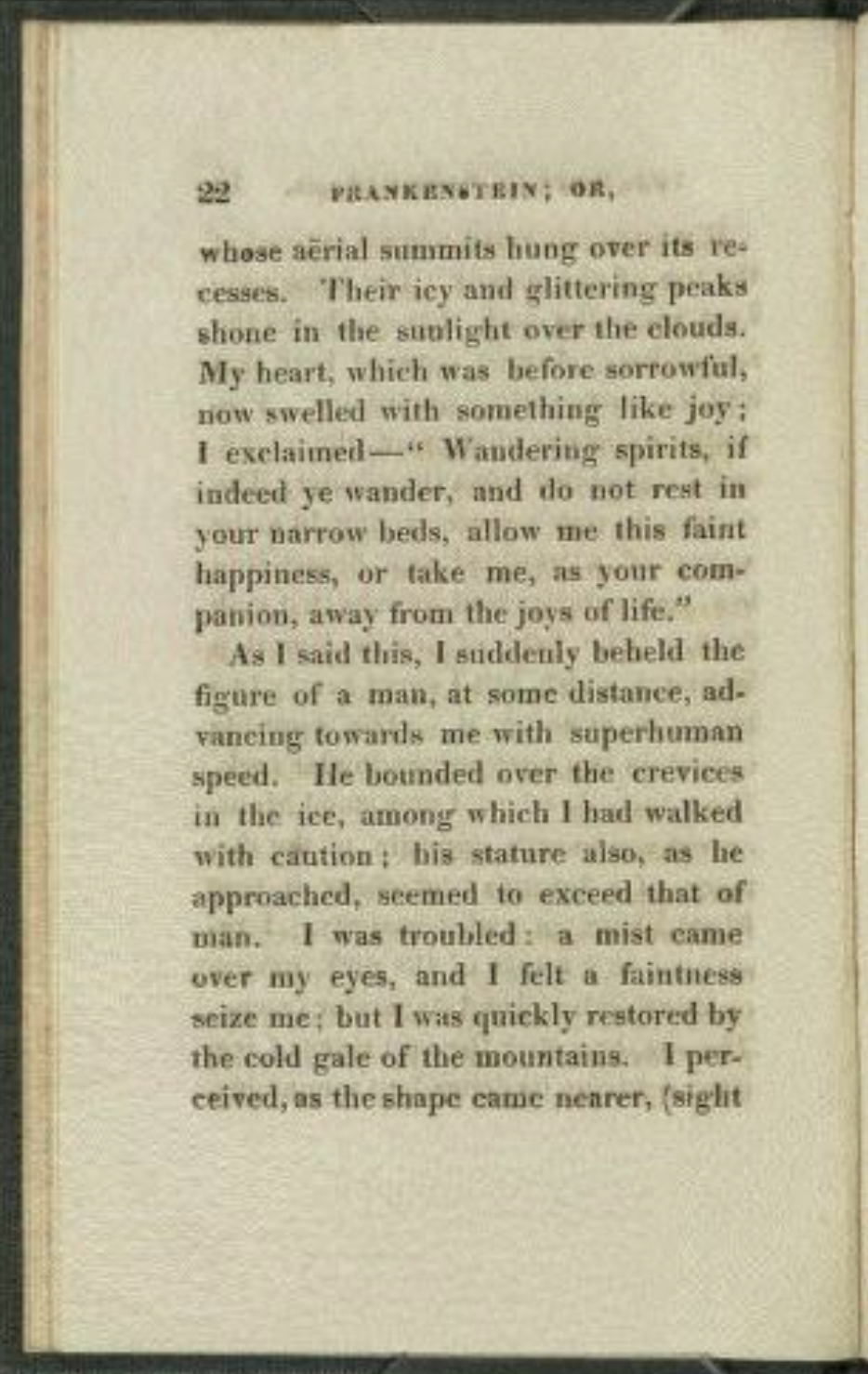


Shortly after Mary Shelley commenced her first draft of Frankenstein she and her husband experienced Mont Blanc and the Sea of Ice. The visit was subsequently incorporated into their letters, poetry, travel writing and fiction. Percy composed a poem, Mont Blanc, while Mary set a central episode in her novel at this sublime location.

In 1817, they published History of a Six Weeks’ Tour through a Part of France, Switzerland, Germany, and Holland: With Letters Descriptive of a Sail Round the Lake of Geneva, and of the Glaciers of Chamouni. There is a notable entry on July 25th 1816:
“We have returned from visiting the glacier of Montanvert, or as it is called, the Sea of Ice, a scene in truth of dizzying wonder. The path that winds to it along the side of a mountain, now clothed with pines, now intersected with snowy hollows, is wide and steep. The cabin of Montanvert° is three leagues from Chamouni, half of which distance is performed on mules, not so sure footed, but that on the first day the one which I rode fell in what the guides call a mauvais pas, so that I narrowly escaped being precipitated down the mountain.”
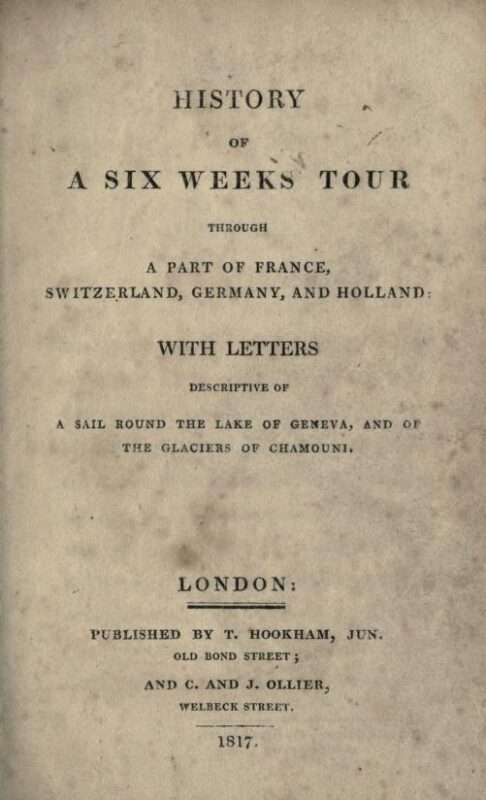
Contemporary editions of the History of a Six Weeks’ Tour (OUP, 2025) note that the:
“°cabin of Montanvert: the ‘Temple of Nature’, built in 1795 to replace an earlier refuge constructed by Charles Blair in 1779 which had gradually fallen into disrepair (Blair’s refuge is the ‘hut’ where Victor and the Creature converse in volume 2, chapter 2, of F1818).”
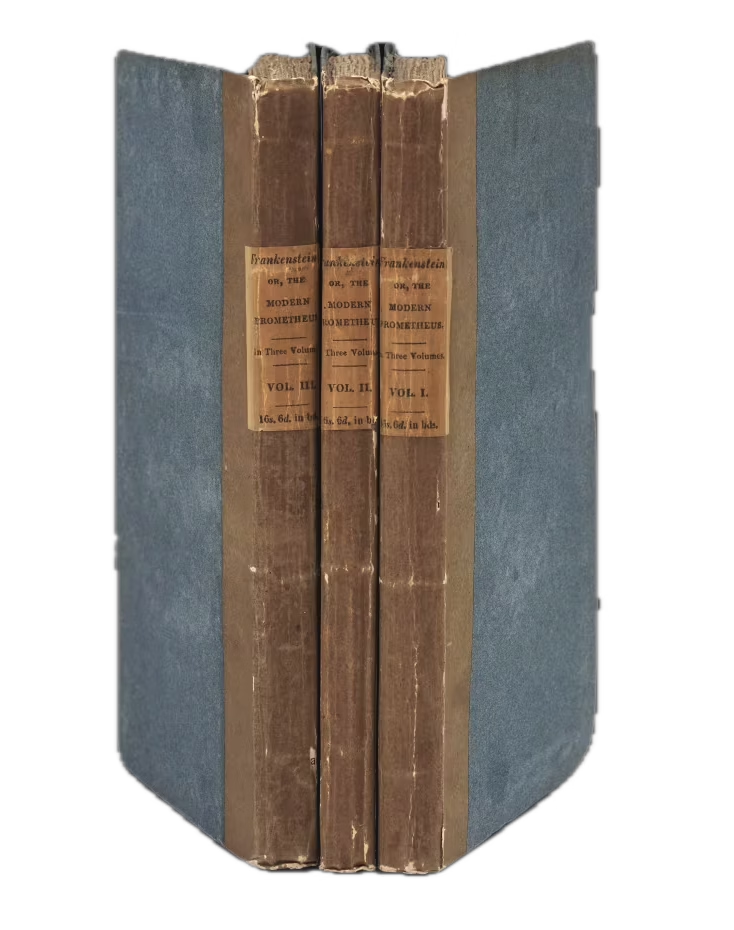
Some have argued that Mary Shelley had Saussure as well as other scientific explorers in mind when she wrote Frankenstein (McKeating 2020; Nardin 1999). The Alps can be viewed, symbolically and literally, as the site of a battle against superstition. Glaciers around Chamonix were still exorcised by bishops in the late seventeenth century but scientifically motivated mountaineers like Saussure championed rational thinking and scientific endeavour. Ironically, Victor has created a monster that is the child of science rather than the Devil. Nardin analyses how Victor’s relationship with the Alps changes in Shelley’s revised 1831 edition of the novel. In the original version (1818) Victor is equally a Romantic wanderer, entranced by the sublime and a scientist, seeking to uncover nature’s secrets. Like Saussure, Genevan-born Victor has become focused on conquest. Shelley’s revisions emphasised scientific pursuit:
“Instead of adoring the peaks for the treasures they willingly reveal, Victor, like Saussure and his fellows, thinks in terms of forcing them to surrender their secret” (Nardin 1999).

This analysis is not at all fanciful and evidence, besides the setting of the novel, is compelling. Saussure was a scientist and an inventor from a patrician and unusually progressive family. He was particularly obsessed by the measurement of meteorological phenomena, inventing and improving all kinds of technical apparatus. Saussure was the third person to conqueror Mont Blanc. Originally, he had offered others a cash incentive to ascend to the summit.
This new knowledge about Orwell’s connection to “the hut” makes re-reading the seminal episode in the novel a pleasurable one:
“Thus I relieve thee, my creator,’ he said, and placed his hated hands before my eyes, which I flung from me with violence; ‘thus I take from thee a sight which you abhor. Still thou canst listen to me, and grant me thy compassion. By the virtues that I once possessed, I demand this from you. Hear my tale; it is long and strange, and the temperature of this place is not fitting to your fine sensations; come to the hut upon the mountain. The sun is yet high in the heavens; before it descends to hide itself behind yon snowy precipices, and illuminate another world, you will have heard my story, and can decide. On you it rests, whether I quit for ever the neighbourhood of man, and lead a harmless life, or become the scourge of your fellow-creatures, and the author of your own speedy ruin.’
As he said this, he led the way across the ice: I followed. My heart was full, and I did not answer him; but, as I proceeded, I weighed the various arguments that he had used, and determined at least to listen to his tale. I was partly urged by curiosity, and compassion confirmed my resolution. I had hitherto supposed him to be the murderer of my brother, and I eagerly sought a confirmation or denial of this opinion. For the first time, also, I felt what the duties of a creator towards his creature were, and that I ought to render him happy before I complained of his wickedness. These motives urged me to comply with his demand. We crossed the ice, therefore, and ascended the opposite rock. The air was cold, and the rain again began to descend: we entered the hut, the fiend with an air of exultation, I with a heavy heart, and depressed spirits. But I consented to listen; and, seating myself by the fire which my odious companion had lighted, he thus began his tale.”
ORWELL’S ANCESTORS
“We are staying with the Blairs & I like it. Nothing has surprised me more, particularly since I saw the house which is very small & furnished almost entirely with paintings of ancestors.”
…………………………………………………………………………………………………………… Eileen Blair née O’Shaughnessy
George Orwell inherited several portraits of his eighteenth century Blair ancestors which had sentimental value to him, as did a family bible containing a detailed tree outlining “the descendants of Charles Blair, Esq., and Lady Mary Blair to whose children their uncle, the Earl of Westmorland, stood godfather” (Fyvel 1982). Family lore records that he wrote under the painting of Lady Mary he had inherited (who I will be writing more about later this year).
Charles and Lady Mary Blair lived predominately in Europe between 1778 and 1795. Blair was born in Jamaica, orphaned from birth and lived with his grandmother from about six years of age before attending Eton College (1753-1757). He married Mary Fane, the Earl of Westmorland’s daughter in 1762, while still a teenager. As a wealthy Absentee Landlord, the immoral profits of slavery funded their privileged lifestyle. This income generated from the Jamaican estates he had inherited as a boy was considerable and the aristocratic connections provided by his marriage and wealth extensive. Poet Laureate, Robert Southey, offers a unique insight into the family.
Researching Orwell’s ancestors – at first very incidentally – has revealed a web of aristocratic, political, literary, scientific and artistic connections which have become fascinating in their own right. Studying Orwell has always been incredibly useful for understanding the history of the twentieth century. Studying his ancestors, from the late 17th century until his birth in 1903, increasingly offers a complex, vexed, occasionally amusing view of British history. It also explains much about Orwell’s own context and eccentricities of outlook which were often noted by his friends.
The question – how much did Orwell know about his own ancestors – is usually considered an unknowable one but my hunch (and a growing body of evidence) suggests way more than has been previously assumed. If you are interested in considering this question further, here is some evidence about this knowledge; his identity; family influences; challenging realities and how cheekily this ancestral knowledge crept into his novels.
This article has been a digression from my wider ancestral research. I stumbled over the story of Blair’s hut and made the connection to Orwell’s great-great-grandfather while reading other letters and diaries. There is much more to share about Charles Blair, Lady Mary and their children.
More anon.
FEATURED IMAGE: Carl Ludwig Hackert, Vue de la Mer de Glace et de l’Hôpital de Blair du sommet du Montanvert (1781). Public Domain
REFERENCES
Berry, Mary, Journals & Correspondence, London: Longmans, Green & Co., 1865
Blair, Mary Lady, “Correspondence with Richard Pulteney”, The Linnaean Society of London, 1777-1780
Bourrit, Marc-Théodore, Nouvelle Description des Glacieres et Glaciers de Savoye, Genève: Paul Barde, 1785
Bourrit, Marc-Théodore, Description des cols, ou Passages des Alpes, Switzerland: Manget, 1803
Coolidge, W.A.B., Swiss travel and Swiss Guide-Books, London: Longmans Green & Co., 1889
De Beer, G. R., Speaking of Switzerland, London: Eyre & Spottiswoode, 1952
De Beer, G. R., “The Diary of Sir Charles Blagden.” Notes and Records of the Royal Society of London, Vol. 8, No. 1, 1950, pp. 65–89
Freshfield, Douglas William, The Life of Horace Benedict de Saussure, London E. Arnold, 1920
Fyvel, T.R, George Orwell: A Personal Memoir, Weidenfeld and Nicolson, 1982
Hill, David, Turner in the Alps: the Journey Through France & Switzerland in 1802, London: George Philip,
Historical Manuscripts Commission, Thirteenth Report, Appendix, Part III: The Manuscripts of J. B. Fortescue, Esq., Preserved at Dropmore, Vols. I–II. London: Eyre and Spottiswoode for Her Majesty’s Stationery Office, 1892
Hughes, I. D. “Pulteney, Richard (1730–1801), Botanist and Physician”, Oxford Dictionary of National Biography, Oxford University Press, 2008
McKeating, Carl Alexander, Mont Blanc in British Literary Culture 1786 – 1826, PhD thesis, University of Leeds, 2020
Murray, John, A Hand Book for Travellers in Switzerland and Savoy, London: J. Murray & Son, 1838
Nardin, Jane, “A Meeting on the Mer de Glace: Frankenstein and the History of Alpine Mountaineering”, Women’s Writing 6 (3): 441–49, 1999
Nussbaumer, Samuel U., and Zumbühl, Heinz J., “Les vues glaciaires de Jean-Antoine Linck – un jalon de l’histoire des glaciers du Mont Blanc du XVIIIe au XIXe siècle”, Journal of Alpine Research, Revue de géographie alpine, no. 111-2, 2023
Saussure, Horace-Bénédict de, Voyage dans les Alpes, précédé d’un essai sur l’histoire naturelles des environs de Genève, Neuchâtel, 1786
Shelley, Mary Wollstonecraft; Shelley, Percy Bysshe, History of a Six Weeks’ Tour through a Part of France, Switzerland, Germany, and Holland: With Letters Descriptive of a Sail Round the Lake of Geneva, and of the Glaciers of Chamouni, Cian Duffy and Anna Mercer (editors), Oxford University Press, 2025
Shelley, Mary Wollstonecraft, Frankenstein; Or, The Modern Prometheus – Volume II, London: Lackington, Hughes, Harding, Mavor & Jones, 1818
Taylor, Patricia, Thomas Blaikie (1751-1838): The ‘Capability’ Brown of France, London: Tuckwell, 2001
Weber, J.B., A Short Account of a Journey to Glacieres, in Savoy, Bath: J Watts, 1778
Whymper, Edward, Chamonix and the Range of Mont Blanc: A Guide, Switzerland: J. Murray, 1898
Windham, William, An account of the Glacieres or Ice Alps in Savoy, in two letters, London: Peter Martel, 1744
Yeld, George (ed), “Chamouni in 1780 and 1786”, Alpine Journal, Vol. 32, No. 217, February 1918. pp 75-76

Discover more from Darcy Moore
Subscribe to get the latest posts sent to your email.
Gina Douglas FLS
Thank you for providing that link between George Orwell’s ancestors and exploration of the natural world of the Swiss Alps. Richard Pulteney’s correspondence is held by the Linnean Society of London so check the online Archives catalogue to see what might be there from Lady Mary. Sadly it has not been. able to digitise it as major conservation work is needed but I have good lists from past grant applications when Librarian and hoping to make the collection more widely available.
Darcy Moore
Thanks Gina. I hope to visit the Linnean Society archives when I am return to London in January, 2027!