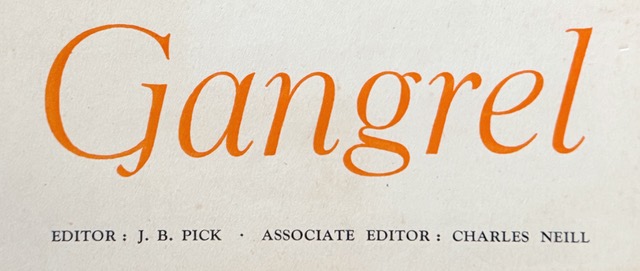
Why I Write is one of Orwell’s most widely-read, quoted and anthologised essays. It was published during the summer of 1946 in the fourth and final issue of Gangrel. What can we learn from examining the “pamphlet” where it first appeared besides that the title is a Scots word (from Anglo-Saxon) meaning “tramp”?
When George Orwell died in early 1950, very few of his essays and articles had been collected and published in books. Inside the Whale (1940) and Critical Essays (1946) contained just eleven. Another eighteen essays appeared shortly after his death in Shooting an Elephant and Other Essays (1950). Half of these were from the weekly column he wrote for Tribune and were included because of “their charm” and because they expressed ideas he had “not developed elsewhere” but with the reservation that these should not be “considered in the same category as the other essays”.
However, his extraordinary output, scattered across newspapers, literary journals and short-lived “little magazines” with small circulations was largely inaccessible and in danger of being forgotten. This was partially rectified in 1968 when four volumes, edited by Ian Angus and Sonia Brownell, cemented his reputation with readers who were for the first time able to gain a sense of the breadth of his achievement. A canon was being shaped which would impact on generations of new readers.
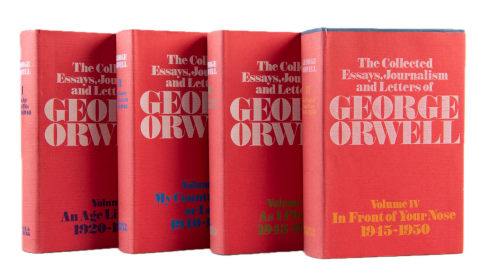
Although each of these volumes was organised chronologically, Angus and Brownell decided to place “Why I Write” at the beginning of Volume I as it provided “a suitable introduction to the whole collection”. They referenced the source as Gangrel [No. 4, Summer] 1946 and listed four other tomes where it had previously been reprinted: England Your England and Other Essays (1953), the only one to also name Gangrel; Such, Such Were the Joys (1953); The Orwell Reader: Fiction, Essays, and Reportage (1956); and, Collected Essays (1961). Each of these collections listed the wrong publication date (1947) for the essay.
In 1998, Peter Davison (with the assistance of Ian Angus and Sheila Davison) truly resuscitated and chronologically contextualised Orwell’s enormous output in twenty volumes.
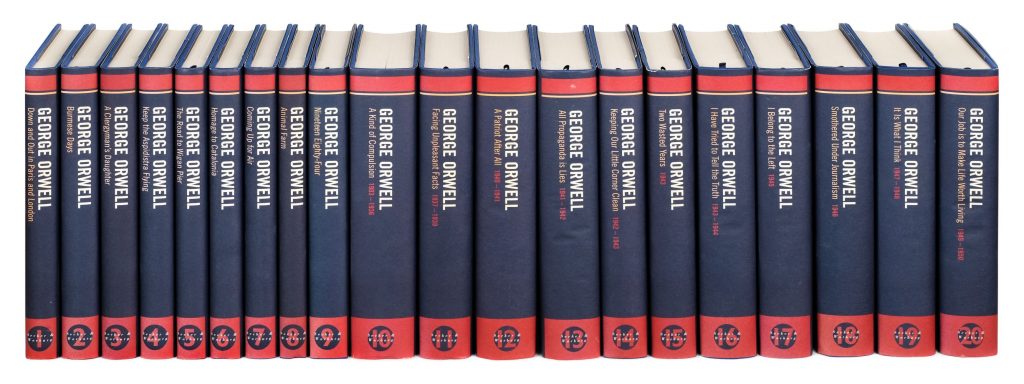
After scouring these volumes, it seems that Orwell only mentions Gangrel to his publisher on a list of “obscure literary papers” to send review copies of Critical Essays (1946):
“I would like it, however, if you could make a point of not missing out any of the papers I write for—for instance, the Evening Standard and the Manchester Evening News; and on the other hand, not missing out the obscure literary papers which are likely to give a book of this type a fairly serious review. I mean, for instance, “Now”, “Poetry Quarterly”, “Polemic”, “Transformation”, “Gangrel” and “Scrutiny”, if the latter is still going.”
That’s it!
Although his seminal essay is extensively cited in innumerable academic papers, biographies and books about Orwell, it is extremely rare for Gangrel to rate a mention anywhere.
Professor Davison’s footnotes are unusually slight regarding the first appearance of “Why I Write” but important. He briefly mentions that the editors, J. B. Pick and Charles Neill, asked a number of authors to explain why they wrote and that Orwell’s response was “placed second”. There are no letters to these editors, biographical or other contextual information except that this was to be the last of four issues (January 1945–1946).
Why was Orwell still obligingly sending copy to the editors of obscure journals in the same year Animal Farm was being published by the American Book of the Month Club and he was being written-up in Vogue as “a defender of freedom, even though most of the time he violently disagrees with the people beside whom he is fighting”?
Orwell was always interested in radical newspapers, journals and pamphleteering. He wrote an introduction for British Pamphleteers Volume 1: From the 16th Century the 18th Century but illness prevented him from editing Volume II: From the French Revolution to the Present Time. Orwell donated his large collection of pamphlets to the British Museum and they can now be read in the British Library.
What can be uncovered by examining the edition of Gangrel, the pamphlet where the essay first appeared – and does it even matter?
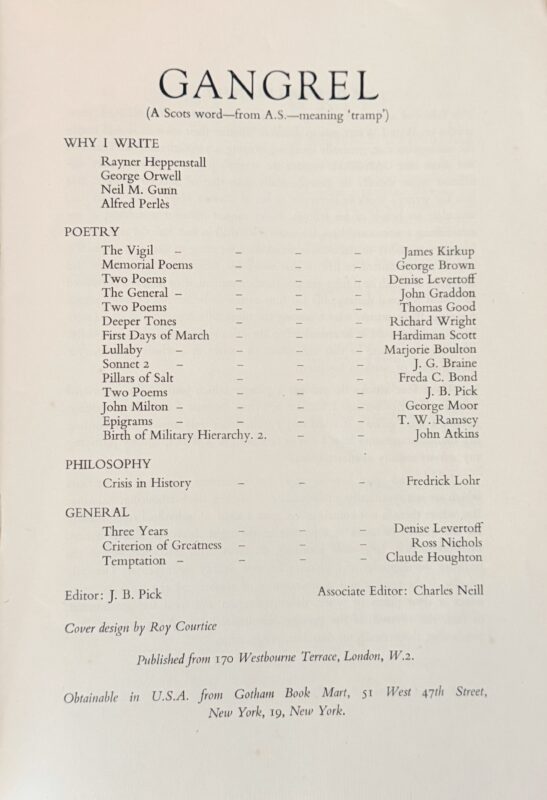
I think it does, especially considering that “one of the features of Orwell’s post-1945 career is his enthusiasm for the anarchist-libertarian fringes of the British left…” (D.J. Taylor, Orwell: The New Life).
WHY WE WRITE
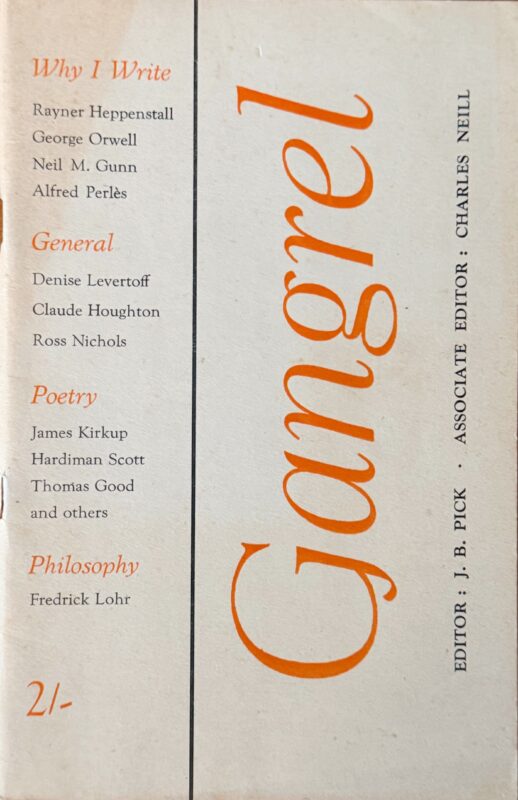
The cover immediately alerts the reader to the writers who have been asked to make a personal statement about their writerly motivations. Reading the editorial note clarifies that the purpose behind the prompt was to discover whether the responses “would justify the assumption that, generally speaking, writing is a vocational task”. Orwell’s famous, oft-quoted opening, is directly responding to the brief:
From a very early age, perhaps the age of five or six, I knew that when I grew up I should be a writer. Between the ages of about seventeen and twenty-four I tried to abandon this idea, but I did so with the consciousness that I was outraging my true nature and that sooner or later I should have to settle down and write books.
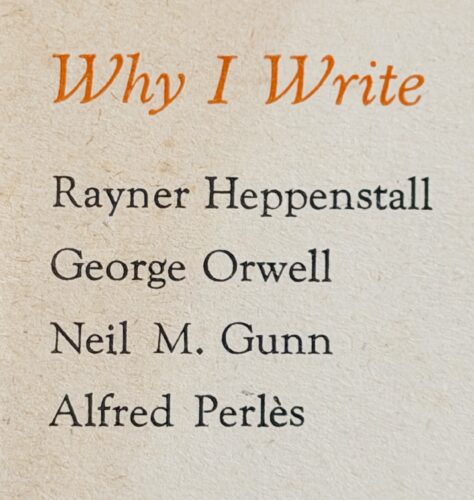
One assumes that relatively few Orwell scholars have read the other three responses (not least because they have never been easy to access). Besides Orwell’s contribution, Neil M. Gunn‘s piece is the only one I can find that ever surfaced again. It was republished in a collection of his essays (1987) which incorrectly lists Gangrel as being printed in 1951. However, there is one notable exception, Peter Marks, who as a post-graduate student understood the context in which Orwell’s essay was published was an important one. He wrote that the essay is “a review of an established career, not a manifesto for one just commenced” but more importantly Marks notes that:
“… the title “Why I Write” suggests a highly personal statement, in the essay itself the “four great motives” Orwell delineates are consciously meant to apply to writers in general. This wider perspective is rarely acknowledged in considerations of “Why I Write,” but a glance at Gangrel, the periodical in which the essay was first printed, proves instructive.” (Marks 1995/2011)
Just briefly, a few biographical points may be useful for those unfamiliar with these names and their connection to Orwell. Heppenstall could justly be described as Orwell’s frenemy. They shared a Kentish Town flat in the mid-1930s where an altercation took place late one night when Rayner returned home drunk. An Austrian who later became a British citizen, Alfred Perlès lived in Clichy with Henry Miller prior to the writer becoming famous. He founded and edited The Booster which Orwell described (in 1937) as “a perfectly ordinary, dam-silly magazine of the pseudo-artistic type that used to appear and die with the rapidity of May flies in Montparnasse in the ’twenties”. Perlès provided important biographical anecdotes about Orwell who visited Miller in Paris en route to Spain in My Friend Henry Miller. Gunn’s connection with the editor will be explored in my next post (Gangrel: ‘A Nest of Anarchists’).
You may find it interesting to read the three previously inaccessible essays before continuing further.
1. Rayner Heppenstall
2. George Orwell
3. Neil M. Gunn
4. Alfred Perlès
Those who take the time to read the four essays will see that each piece confirms Pick’s belief that writing is vocational. There are some similarities in their motivations, all sharing a sense that writing originates in a deep, partly involuntary need rather than a calculated choice. All treat authorship as a means of discovering or clarifying something: the self, experience, reality, spiritual meaning or political truth. Ego and self-expression matter, but none regards literary ambition alone as sufficient.
Heppenstall conceives writing principally as a personal, spiritual and psychological vocation; an attempt to understand consciousness, experience and the writer’s relation to something beyond ordinary material existence. His religious and philosophical preoccupations make writing essentially exploratory. Heppenstall writes to explore the self and its spiritual predicament “in order to be saved”. Orwell, by contrast, ultimately conceives writing as a public and political act. Although he acknowledges egoism, aesthetic pleasure and historical curiosity among his motives, the decisive experience for him is the politics of the 1930s, especially Spain. After 1936, “every line of serious work” has been written “against totalitarianism and for democratic Socialism”. Orwell writes to confront the world, expose political falsehood and make truth publicly visible. Orwell puts “aside the need to earn a living” from his response.
Gunn is primarily concerned with the lyrical, metaphorical and unknowable mystery of artistic creation. He stands closest to Orwell in his candour about money, success, failure and the practical life of the professional writer. Both regard writing as a lifelong compulsion that transforms lived experience into literature and hope to resist the temptations of commercialism. Yet their conceptions of creativity diverge profoundly. Orwell believes that a writer can identify and explain the motives behind his work, culminating in a consciously political purpose. Gunn distrusts such explanations, presenting creativity as an instinctive, mysterious process beyond rational control. Perlès too repeatedly insists that the origins of writing lie beyond conscious understanding. Creativity is a divine force to which the writer has only partial access, acting as a conduit rather than a creator. Despite frustration, dissatisfaction, and the persistent gap between inspiration and execution, Perlès continues to write because artistic creation is his vocation and participation in a greater creative order. Like Gunn, he just does not know why he writes.
Peter Marks has previously pointed out that “the individual explorations of why each writer wrote” vindicated Pick’s personal beliefs about the vocational nature of writing.
We can only wonder what the other writers – Claude Houghton and Henry Miller – who were invited to contribute but never managed to produce a response, would have said.
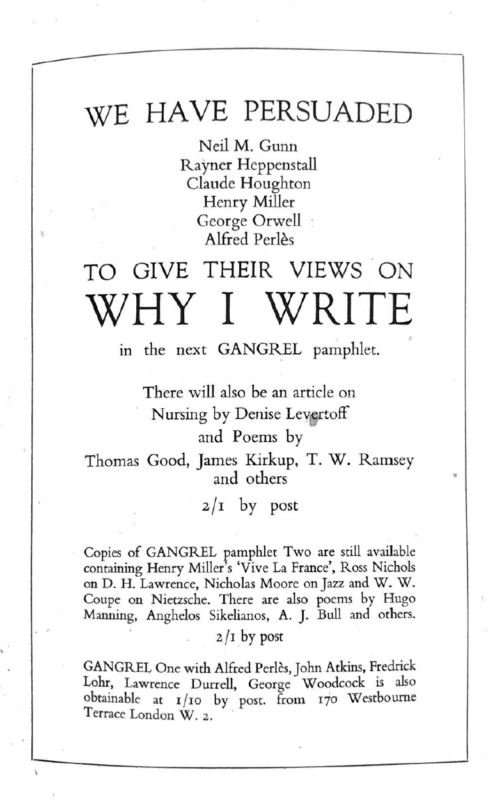
GANGREL
What can we learn by closely examining the fourth issue, where Orwell’s essay appeared, with Pick’s initial editorial Gangrel #1 in mind?
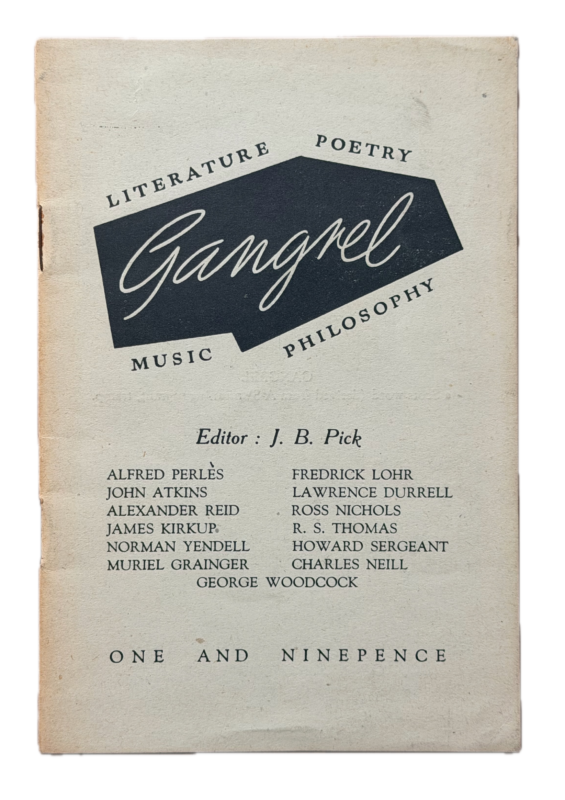
Reading the explanatory editorial letter from J.B Pick to Charles Neill in the first instalment of Gangrel (January 1945) reveals at least one reason why Orwell, the great exponent of anti-totalitarian writing, would be convinced to provide copy for a later edition:
Dear Charles,
You’re not keen on the idea of another “small review.” Neither am I, in your sense. If it means another group of young men insisting upon their own importance we are best without it. But I don’t agree when you say too many of them exist already. The more there are the better. Whether or not a review has a right to exist or not is shown simply by its sales. If there is a public for it that public will be found. If there is not then the venture is a waste of time. But it is a fact that these literary reviews are in the front-line against the world-wide advance towards totalitarianism. This is where I’d like GANGREL to come in.
I want to demonstrate the writer as a man with a vocation; to point the way to a free, vocational society. Present society will hardly recognise the artist except insofar as he allows himself to be moulded by it: it is his duty not to be moulded. The war has ended, but things won’t change for the better spiritually, even if materially they may, and I see no reason to trust the pronouncement of politicians even on the material side.
The general desire for security above all things may be natural but that doesn’t make it good. A return to the natural order of the Garden of Eden is hardly to be hoped for at this stage in history, or at any stage in the future. Natural man is merely a “happy” animal—consciousness and unhappiness grow together. Russia has tried a return to Eden—the result is the ant-state. I prefer men to ants. As the ant-state seems to be appealing to all the governments of the world it is obvious that the writer is to become a gangrel if he can’t attain to a chair in some Ministry. We may as well face up to it. We’ve got to resist communism, capitalism, americanism, the State, every “ism”, which threatens to dominate society. And we’ve got to explain why.
I want to stir the intellectual water. If I offend a few people it doesn’t matter. The effort to produce a GANGREL has in itself been a revelation. I knew who I wanted to contribute and there was no harm in asking. I found generosity and rudeness, kindness and superciliousness, friendly handshakes and patronising headshakes. But the kindness far exceeded its opposite. I know now where an unknown writer stands and who are his friends.
I’ve tried not to stick too closely to the article I’ve written for GANGREL in selecting its poetry—opinions are good but tolerance is better.
Yours,
J. B. P.
Pick’s assertion that literary reviews were “in the front-line against the world-wide advance towards totalitarianism” is possibly as romantic a notion as the appendix to Nineteen Eighty-Four (Orwell refused his American publisher’s request to leave it out for a very good reason). There is a clear implication that Big Brother and the totalitarian state have been defeated by language. Standard English has not been superseded by the reductive horror of Newspeak (see my forthcoming essay). It is also significant that Pick (who, like Orwell “sees no reason to trust the pronouncement of politicians”) wants to “demonstrate the writer as a man with a vocation” further illuminating the brief that Heppenstall, Gunn, Perlès and Orwell were following when drafting their essays for Pick and his associate editor.
There are important contextual clues in Gangrel #1 and #4 as to why Orwell published in this little magazine. The back cover of #1 advertises another “little magazine” edited by John Atkins (1916-2009).
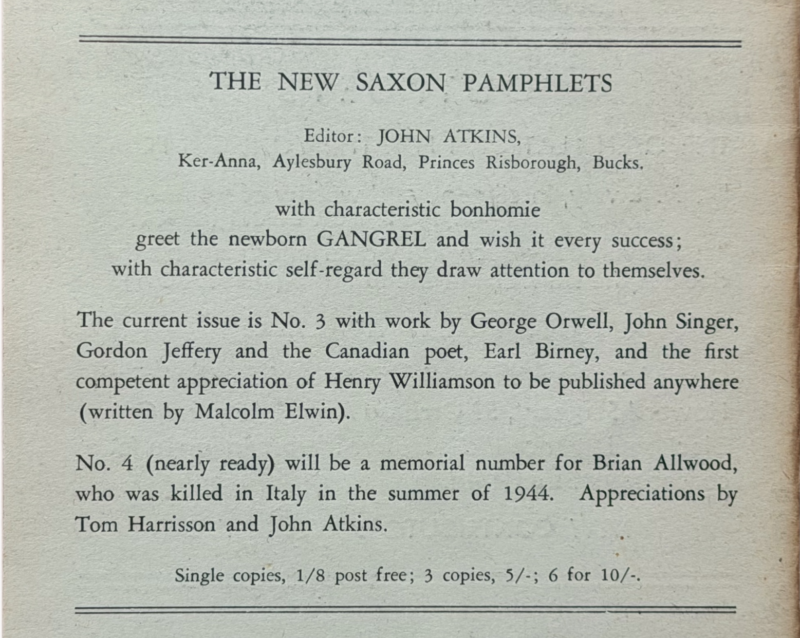
Atkins, a novelist, poet and playwright wrote George Orwell: A Literary Study (1954), the first of the early pseudo-biographies. His tenure as literary editor of Tribune (1942-1943) was truncated as a result of being drafted into the army. He was replaced by Orwell who had resigned from his job at the BBC. Although willing to “fight Hitler”, Atkins was not enamoured with army life and often absented himself without leave for less than 20 days as not to face desertion charges. Pick’s recollections about Atkins and 170 Westbourne Terrace (behind Paddington station) where Gangrel was published, reveal a network of associates which will be explored in my my next post.
REFLECTION
In Gangrel #2 J.B. Pick explained why the cover price was high for this “pamphlet”:
“There is no hope of a writer earning his livelihood unless editors pay him. GANGREL is a high price because it pays contributors. The non-paying literary reviews are doing disservice to their writers to ensure that they themselves remain in existence. Our view is that we should prefer to lose money than to refuse payment.”
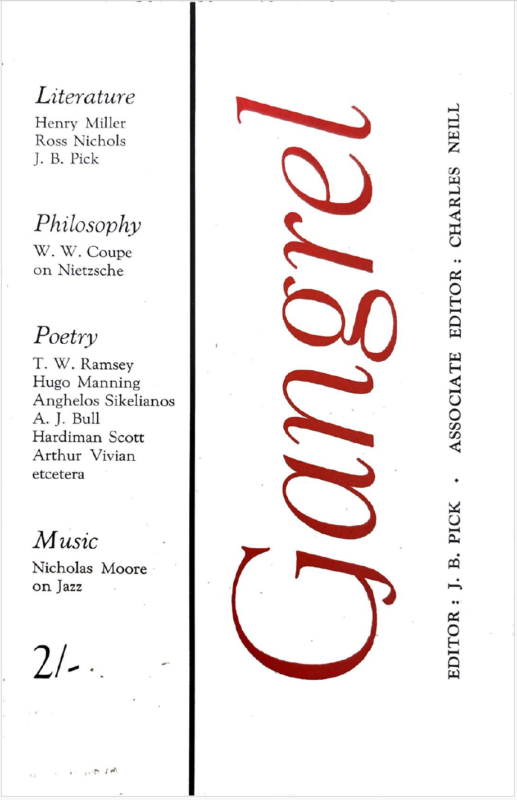
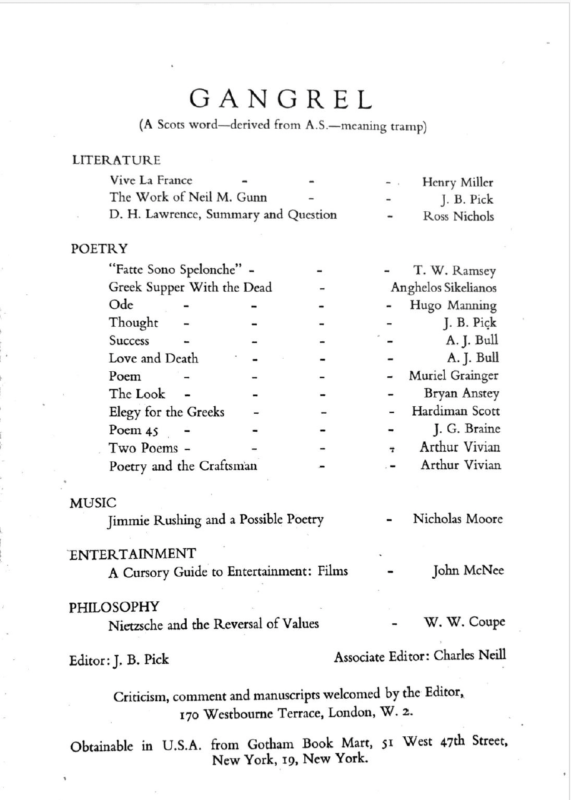
George Woodcock noted in The Crystal Spirit: A Study of George Orwell that ‘Why I Write’ was written “for his friend John Atkins to publish in a little magazine called Gangrel” and “at best” and “characteristically” written for “token payment”.
Many years later, Pick reminisced in a perceptive article about Hairmyres Hospital, where Orwell was treated for tuberculosis, that the writer refused to accept any payment at all:
“… in 1945, when I was editing a small magazine of which Orwell could not have heard, I asked him for an article, “Why I Write”, and he wrote it readily, taking no payment—which is typical of his kindness and generosity.”
Peter Marks cautioned against the temptation of seeing Orwell’s essay as a “testimony” or “confession”. Of course, that is how it has been viewed endlessly – with obvious justification – by the many writers who have quoted from it. Bernard Crick, in the first full biography (1980) of Orwell wrote:
Each of us may even speculate that we have a “true character” which is not fully realised in our actual life. Orwell himself began a poem in 1935 “A happy vicar I might have been/Two hundred years ago”, but the poem goes on to point ironically to the impossibility of this when “… born, alas, in an evil time’; and when he quotes this poem himself in his “Why I Write” of 1946, it is to say that “the Spanish war and other events in 1936-37 turned the scale and thereafter I knew where I stood”, that what “he most wanted to do” was ‘‘to make political writing into an art”. Alas indeed, the only life one can write about is the life someone actually led in reaction to actual events in a particular “evil time’, not about “true character”. Otherwise biography descends into psycho-drama, just as so many people in an ultra-individualistic culture can waste so much of their sensibility and frustrate so much of their life in wondering who they “really are”. Our human identity consists in relationships, not in inwardness.
The final (poorly expressed) sentence is very contestable but regardless, connecting the dots, there are some fascinating inter-relationships to explore with Orwell’s “enthusiasm for the anarchist-libertarian fringes of the British left” in mind.
The second part of this research, Gangrel: ‘A Nest of Anarchists’, will explore the milieu who resided and collaborated with J.B. Pick at 170 Westbourne Terrace c.1944-1946, including John Atkins. My understanding has broadened due to the kind support of both the Pick and Atkins families.
Thanks are due to Chris Angel for scanning editions #2 and #3 of Gangrel and to Peter Marks for chatting with me about his post-graduate research.
REFERENCES
Burns, John, “Obituary: John Barclay Pick, Writer”, Scotsman, 2 February 2015
Gangrel, Number 1, January 1945
Gangrel, Number 2, 1945
Gangrel, Number 3, 1946
Gangrel, Number 4, Summer 1946
Marks, Peter, “Where He Wrote: Periodicals and the Essays of George Orwell”, Twentieth Century Literature, vol. 41, no. 4, 1995, pp. 266–83. JSTOR, https://doi-org.lonlib.idm.oclc.org/10.2307/441531
Marks, Peter, George Orwell the Essayist Literature, Politics and the Periodical Culture, London: Continuum Publishing Corporation, 2011
McCleery, Alistair (ed.), Landscape and Light: Essays by Neil M. Gunn, Aberdeen: The University Press, 1987
Orwell, George, The Collected Essays, Journalism and Letters of George Orwell: An Age Like This – Volume 1 1920–1940, London: Secker & Warburg, 1968
Orwell, George, I Belong to the Left: 1945, The Complete Works of George Orwell – Volume 17, Secker & Warburg, 1998
Orwell, George, Smothered Under Journalism: 1946, The Complete Works of George Orwell – Volume 18, Secker & Warburg, 1998
Orwell, George and Reynolds, Reginald, British Pamphleteers Volume 1: From the 16th Century the 18th Century, London: Allan Wingate, 1948
Perlès, Alfred, My Friend Henry Miller, New York: The John Day Company, 1956
Pick, J. B., “A Bed at Hairmyres”, Scots Magazine, No. 121, April 1984
Taylor, D.J., Orwell – The New Life, London: Constable, 2023
Woodcock, George, The Crystal Spirit: A Study of George Orwell, London: Jonathan Cape, 1967

Discover more from Darcy Moore
Subscribe to get the latest posts sent to your email.