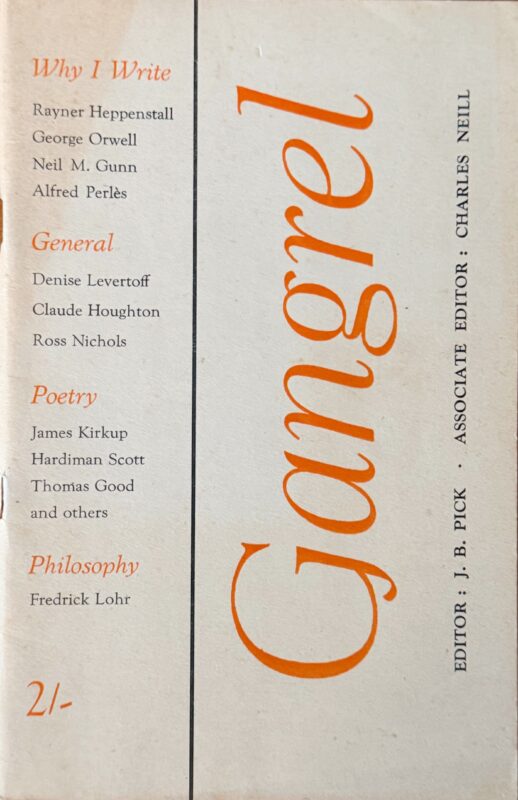
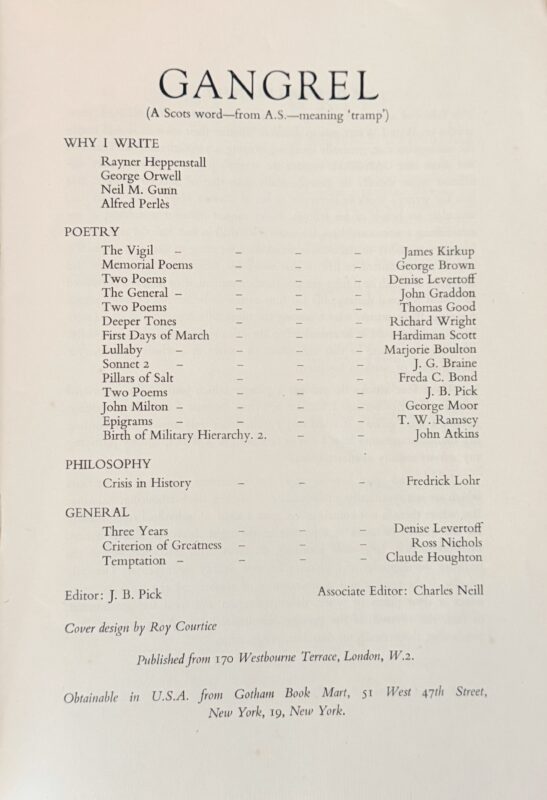
1. RAYNER HEPPENSTALL – WHY I WRITE
Gangrel, Number 4, Summer 1946, pp. 3-6
In fact I am more accustomed to consider the question why I do not write and the question why I do (sometimes, but far too infrequently) I am inclined to dismiss by saying that I have no other profession. Writing has become equivalent for me to the practice of virtue in a religious man. It is the sin of not-writing which occupies my thoughts and torments me. In any case, the question why I write (when I do) is three questions—what caused me to start writing and to continue, what particular intentions involve me in particular kinds of writing and particular pieces in those kinds, and what transcendental principle do I think justifies me, if any.
I did not start writing until after I had decided I was a writer. For instance, I remember that I wore a bow tie to show my solidarity with poets before I had produced a line of verse. The immediate cause of my first poem was amorous confusion. I wished to show a young woman called Margaret Binns exactly what I felt about her, and I hoped by this demonstration itself to bend her will, which was rather inflexible. From a practical point of view, the poem was a failure. After that, imitation became my chief impulse. I was a student at Strasbourg, and I wrote in imitation of French poets. Clearly, this imitation was part of an effort to remove myself from the social group into which I had been born and to identify myself with another. The situation for me was not what it is for a young man of the middle class sent as a matter of routine to a public school and then to Oxford or Cambridge. On the other hand, I am not a proletarian writer pur sang. My background was proletarian, but my father believed in education, intended me to go to school till I was sixteen and was then manoeuvred by me into letting me proceed to a provincial university to fit myself to be a school-teacher, a thing far from my thoughts, though I did in fact teach for seven months.
So I began. I got myself slightly noticed by writing for The Adelphi and The New English Weekly. Through The Adelphi I was given by Messrs. Jonathan Cape a contract to write a monograph on Middleton Murry, without so much as preparing a synopsis. This, in 1933, was a remarkable piece of luck for a young provincial without connections. From this point, I starved, but I never “looked back”.
The list of motives for which I have since written this or that would be a long one. It would include:—
To make money—but very rarely and only after I had married.
To aid a cause—again very rarely and only before I had married.
To be rid of a persistent image in my mind.
To prove to myself (and to a person who had said I couldn’t) that I could write a novel if I cared to.
To remind others of my existence—the chief motive while I was in the Army.
Latterly, because I am paid to write and would feel very sinful if I did not produce a script once every so long.
To pass the time.
To announce a discovery.
To denounce another writer who seemed to me to be writing in the wrong way.
To clarify my own state of mind.
To please the person written about.
To project myself into more agreeable surroundings.
To enlist sympathy.
To expose the over-clothed, but on the other hand, also to clothe the naked.
The list could be more finely graduated, for there is hardly a motive conceivable for which I cannot think that I have at some time written. And I must presume that the most trivial piece of writing done by anybody at any time rests upon a complex, a Gestalt of motives, a large part of which are inaccessible to the writer’s conscious mind. Writing, like all the more strenuous activities, is habit forming. The more you write, the more you have to write, and the more unhappy you feel if you are not writing. It used to be supposed that there was a specific occupational disease called cacoethes scribendi or “writer’s itch,” which afflicted elderly literary hacks. Unlike tennis elbow or housemaid’s knee, it was thought to be vaguely shameful. In those days, a belief in direct inspiration had been widely canvassed. The underlying association was no doubt with capacity of another kind, in which desire commonly outlives performance and with a fair regularity causes otherwise reputable old gentlemen to appear in the police courts.
But a man’s existence is bound to take shape. That creative anguish may at times give place to effortful preoccupation is no shame to a man who at the very least makes our common human situation a little more explicit than it was. And this, I suppose, is the transcendental principle to which all activity as a writer must be referred. It is necessary that life shall not be lived blindly. Man’s place in the great chain of being is marked chiefly by self-consciousness, by long memory and by varied intentions. The written word is the chief guarantee of his humanity. The innumerable perversions of journalism and coterie literature never quite destroy this humble, continuous good. Better a corrupt press than no press at all. Life without the written word is unthinkable. Its archives are the most valuable possession of the human race. One adds in one’s inconsiderable way to those archives.
This does not mean that the valuable part of literature is the assembly of factual information. Humanity requires a continuous record of ways of feeling about things and ways of writing about feelings too. The archive value of a poem or a novel is no slighter than that of a scientific publication or a mass observation survey.
But also it is necessary that the individual existence should be illuminated and clarified in its private, vital movement from one phase to another. I require to make my own concrete situation explicit, and a large part of my duty to my neighbour is to prevent him reverting to animal unconsciousness. This need lies not only at the root of the forms of writing but also of those exalted and penetrating discussions which take place in public houses and less frequently in drawing rooms. Individual men do not exist in order to make up a society. Social life is formed in order that individual existences may press together, set up tensions and elucidate each other. But its written archives are the best that society can provide to the individual man, and societies are justified by their explicitness and not by whether or no they have made it easy for the individual man to live in decency and comfort.
In other words, I write for a metaphysical and religious reason. I write in order to be saved. And this is true not only of manifestly “serious” writing, but no less of the more routine work that I do. In particular, the writing of any sort of dialogue has the widest implications, in its recognition of and identification with other people.