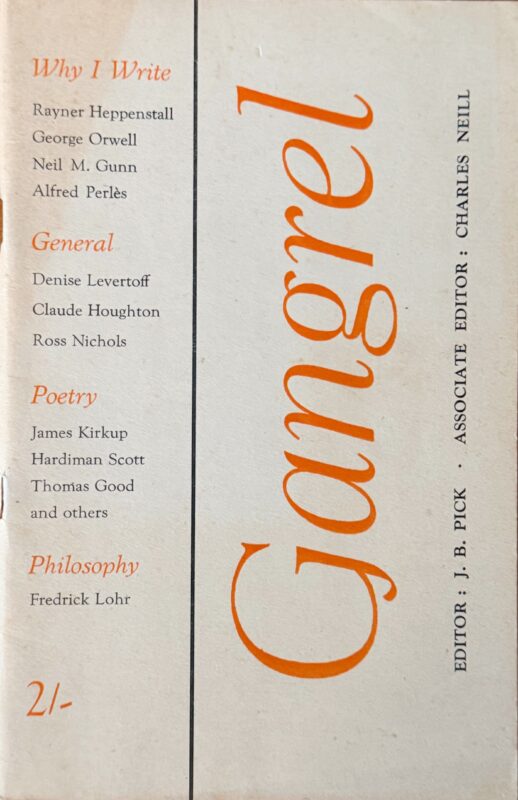
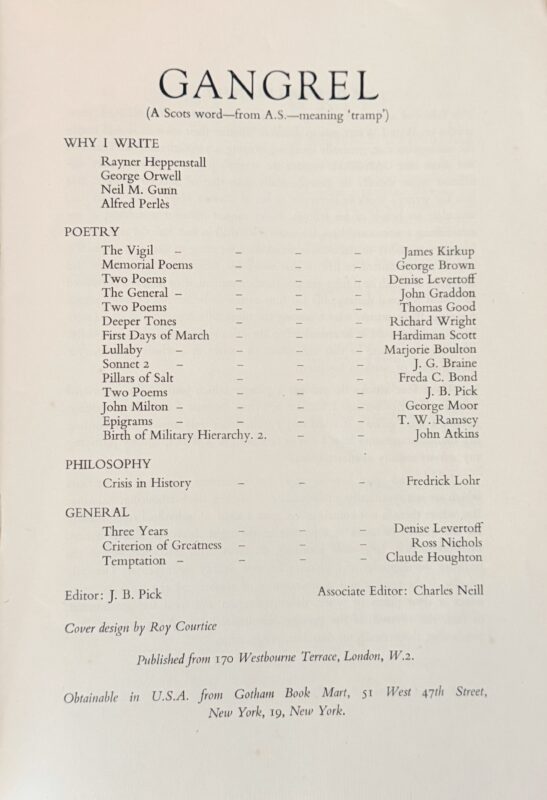
3. NEIL M. GUNN – WHY I WRITE
Gangrel, Number 4, Summer 1946, pp. 10-11
Why do I write? I haven’t the foggiest notion. The mind baulks before the personal question and puts up the shutters. But presently it saunters out round them prepared for a saving game of generalisation. One writes for the same reason as another makes boats or rockeries or horn spoons. Man likes making things. Where I was a small boy, a grown man gave his oath ‘before my Maker’. The old Scots poets were called Makars. Why we—or the Makar—should want to make or create things is still to me, despite Pavlov’s dogs and materialist psychology, pure mystery.
However, analysis is our game; perhaps a sublimation of the old hunting instinct whereby, in the absence of lions and tigers, antelopes and hares, we hunt atoms and souls through universes and jungles to their inmost lairs. Sex, power, money—there’s a simple beginning: a fellow writes for money.
And the first money is bright, incredible. Contrasted with the weekly wage envelope or even the monthly cheque, it is fairy gold, to be thrown abroad as a tree throws its leaves. It equates the act of making, which has been filched from the wage envelope. This is luck. From the essay or short story to a novel. The novel is a Book Society Choice. The golden leaves fall as in Vallombrosa. You walk in at the door of the house you got other makers to build on credit and call it your own. Miracle. And now, besides, there’s another book.
But this time, alas, your helpful and courteous publishers look glum. They are prepared to publish, but . . . And in a flash you see that if you persist in this course—when you could pursue the earlier one—there are to be no more golden leaves; worse, the ‘promising’ tree itself will be publicly axed; worse still, you are aware it is not much of a book, perhaps even a bad book. Yet you persist, smiling, pig-headed, incomprehensible. And in due course the publishers’ dire prognostications are fulfilled. Actually in the old legend the fairy gold when brought to the light of common day turned into horse dung. And you think to yourself: my God, how did these primitive myth-makers know about money and publishing?
Then a really astonishing thing happens. Something—probably that primitive snake in the grass—grins. You were nearly had, he says, but now you’re free again. And you can pelt him with the sourest grapes you can lay your hands on. It makes no difference. He enters into fathomless conspiracy with you. His arabesques glitter with laughter in the sun.
Meantime that word primitive has put me on the spoor of something (which is why I write). A book on field anthropology—Sex and Temperament by Margaret Mead—slips into mind. I remember her admirable description of a poor hill tribe in New Guinea (which the Japs were so accidentally anxious to civilize). They lived in a truly communal way and got the greatest fun from cultivating one another’s gardens. A gentle affectionate laughing people who could not understand violence. For certain purposes, however, they needed a “big man”, a leader or fuhrer. So they caught young what looked a likely lad and got him to shout ersatz insults at his opposite number from across the valley. A real Hitler or Mussolini at his declamatory best would have burst into fragments upon their awe and/or laughter. Even their own fuhrer when fully trained remains uncorrupted by power, waiting for the day when he may retire and laugh happily ever after. The day is achieved in the time dimension when his eldest child reaches puberty. So, as we say, it was up to him to get cracking on the sex business.
Primitives, of course. No conception of Progress. But from this aspect of their culture pattern, does no echo of the laugh come through to us? Would a wise old Chinaman smile? A Yogi contemplate? A Christian saint or mystic understand? Where does Marx come in? And the psychoanalysts?
Success, money, Fuhrer, horse dung. Odd notions and contrasts begin to trouble the writer. He is aware that for some inexplicable reason raw material is starting to collect. Arguments like elvers tie knots on their own tails. He even hears beforehand critical jibes about his searching back through diffusionist theories to a Golden Age, a Garden of Eden. But he doesn’t worry, for at least he knows a lot about culture patterns; and is primarily concerned with his own amazing one here to-day—and perhaps to-morrow.
And now from everywhere—work, politics, economics, parties, committees an’ all—material of a raw relevancy flows fatally in; until the whole thing is a morass mocked by a will o’ the wisp, an elusive glimmer of light, for which he has no lantern. No fable. No conceivable book. How superbly lucky are the fellows who get wage envelopes! Up go the shutters. And then one day—only heaven knows how or why—he observes his unfortunate hand beginning to make scrawls on the mud of the morass with a crooked stick.
And then again—for he realises now that it is all pure mystery to his bloody cost—he makes the astounding discovery that what the stick is designing has apparently nothing whatever to do with success, tribes in New Guinea, fuhrers, or Gardens of Eden. Instead, here are fellows sailing a boat, or working at a bench; or a girl tranced by a singing blackbird while she is thinking of something else. Man emerging from the sucking morass to sing again with a vivid spontaneity of the spirit. . . . Is that the hidden notion of it all? Or what? And he must be careful (his own culture pattern being what it is) to slaughter the poetry in his prose. Off stage a monotonous Indian voice is intoning: All is a striving and a striving and an ending in nothing. How profoundly right the fellow is! Comforted, you irrationally get hold of the stick again. To hell with poverty, let us kill a hen. You begin to write.