EDITORIAL NOTES
Gangrel, Number 4, Summer 1946, p.2

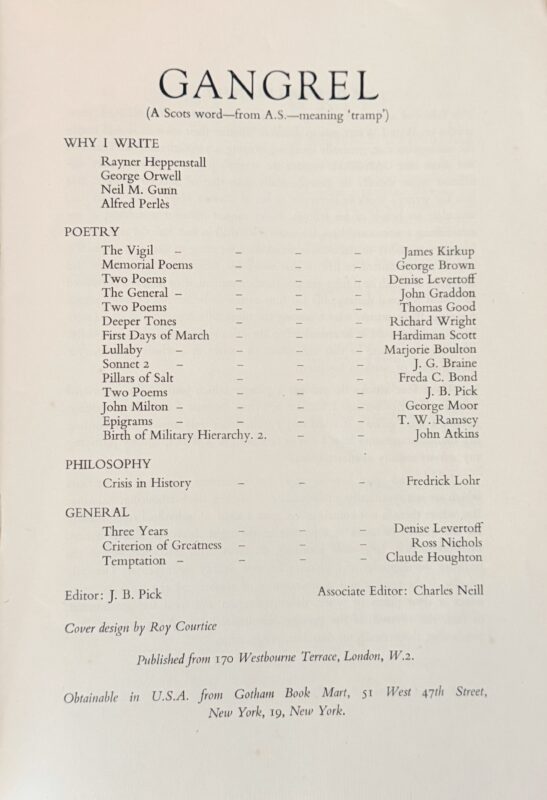
The Editorial aim in requesting writers to contribute to GANGREL these articles on WHY I WRITE was to discover whether their answers would justify the assumption that, generally speaking, writing is a vocational task. This does not mean that GANGREL regards the writer’s job as more essentially significant either socially or metaphysically than that of another worker. But it is the writer’s work to interpret, to be, as Rayner Heppenstall points out, articulate on behalf of his fellows. If we cannot discover a method of re-establishing a vocational basis for society we shall in fact lose the right of the human personality to discover in freedom a meaning in life and work. If a man is not permitted to live in that work for which he is most fitted and adequate, in which he is fully extended and consumed, then he is not permitted to possess personal destiny; life for him comes to be devoid of fundamental meaning. If the writer, who is among the most fully conscious of men (were he not so, how could he be articulate?) is not able to justify himself vocationally, what hope can there be that individuals in society as a whole will discover the meaning of work in vocation?
These four articles do provide a picture which justifies the vocational attitude: ‘I write because I became a writer, because I can’t help writing, because I was “called”. If asked why I write I can only answer by recording my life, demonstrating how I did in fact become a writer, and by justifying my activity socially or metaphysically.’
There is no space here to apply the vocational argument to activities which are not specifically intellectual: coal-mining, dock-labouring, sailoring. But where there is not conscious vocation a sense of individual responsibility for the quality of work is a pointer in the right direction. Centralisation, mass-production, large-scale planning, do away with this sense, where the ordinary development of capitalism has not already destroyed it. The only solution is the control and administration of industry by the workers themselves at their places of work, de-centralisation and local self-government. In fact, the reversal of the present State-centralist tendency, practically a Syndicalist, theoretically an anarchist, programme.