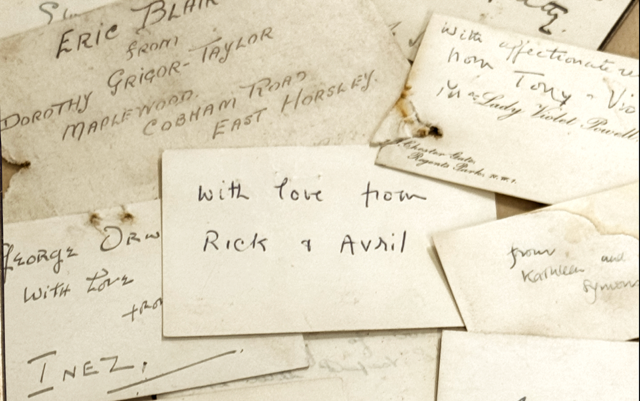
“Came home to hear [illegible] Eric Blair is dead.” Jack Common
Archival research into the melancholic world of the past, where nearly everyone who lives on the page is long dead, can be incredibly poignant – no matter how long ago the events being recovered took place.
Turning the pages of Jack Common’s near illegible diary to that fateful date, the 21st January 1950, revealed a brief entry, written on a very cold Saturday about the sad news of his friend’s demise. Common, a genuinely “proletarian writer” had known Eric Blair for twenty years. From very different class backgrounds, they’d met in London as fledgling writers before the pseudonym George Orwell was coined.
The simplicity and ordinariness of Common’s entry – on such a wintry day – felt very stark. There was no new information, it added no great insight into Orwell or Common but reading it induced a deep sadness; the melancholia of archives.
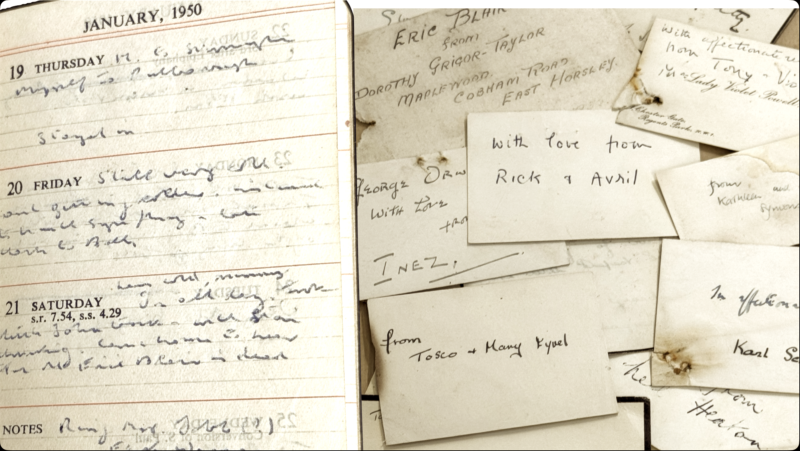
Finding the small cards attached to the flowers from Orwell’s funeral was a genuinely poignant experience. Amazingly, they had been preserved, creating a unique record of those friends, professional associates and family (what remained of it after the deaths of his mother, father, eldest sister, several aunts and uncles in the preceding decade) who were in the congregation or mourned from afar.
Often faded into illegibility from water damage, the cards appeared tear-stained.
The one from Richard Blair, Orwell’s six-year-old son – written by his father’s sister, Avril – was particularly affecting. I showed it to “Rick” while preparing for a presentation at University College London, where his father had died in the hospital.
Richard has spoken about his life with his father and Orwell’s tragic premature death from tuberculosis many times to audiences who feel privileged to hear the story. Understandably, these fading documents had a powerful impact on the Orwell devotees in the audience too, possibly similar to what I felt uncovering them in the tomb-like silence of an archive.
On a lighter note, the sombre nature of these archival finds was contrasted with an amusing anecdote from a recently discovered letter Orwell wrote to a friend about his son, which Richard kindly read aloud to the audience:
“Richard is getting enormous, and is tremendously active and well. He loves working on the farm, fishing and so forth. Recently he took to smoking, I am sorry to say, but he almost immediately made himself so sick that he has never repeated it.”
THE 18TH CENTURY
Moving further back into the past, diary entries recording a mother’s grief and self-recrimination at the death of a son, humanise Orwell’s 18th century ancestors who have proven such fascinating subjects for research. One cannot help thinking of Lady Macbeth while reading the entries made by a sixteen-year-old diarist in 1795 about the travails of “the Blairs” who were significant family friends:
FRIDAY 13 MARCH
… tonight as I have been very much afflicted hearing what unhappy tidings Mr. Blair has received from England which is the death of his eldest son Harry, he died at St Domingo of a malign fever—Lady Mary is quite in despair it was her favourite—I pity them much as it is very dreadful to hear of the death of anybody you love Especially of a son or brother.
WEDNESDAY 18 MARCH
Lady Mary Blair talks of soon going to England. How sorry I shall be if she carries her project into execution as there will remain no English here at all…
THURSDAY 19 MARCH
I walked out with Mary Blair (teenage daughter) We went to a great field by the Danube where we could run very nicely. It is a pretty place but there is not one tree so that in summer it will not be possible to walk there. In the evening I went at Blairs Lady Mary was in a horrid humour. She gets every day more cross and her only wish is to get to England as she now abhores this country. She plagues poor Mr. Blair to death and his servants sayes that he never has been so naughty as he is now.
FRIDAY, MARCH 27TH
I went out in the morning with Mary Blair and spent the evening with her. Lady Mary is always worse and worse she says she has kild her son as she asked that plan for him and will not resign to the almighty but gets quite foolish and Child (sic) They will go as soon as Mr. Blair gets well of his Gout.
SATURDAY, APRIL 5TH
We went at the Blairs this evening. Mr Blair is better of the Gout but Lady Mary is always the same and cries continually, dont sleep, thinks of her sons ghost and always says that she kild him. We all think that she’ll get mad.
“Harry” was Lady Mary Blair’s son, Henry Charles Blair (1775-1794) who died of fever while serving with the 23rd Regiment of Foot in the campaign to quell a rebellion of enslaved persons on the island of Saint-Domingue. The poet Robert Southey wrote a description of Blair, who was his school friend:
“That fever proved fatal to a good many of my Westminster school-fellows, who, some of them because they were fit for the army, and others because they were fit for nothing else, took to that profession at the commencement of the revolutionary war. Rather a large proportion of them perished in the West Indies. “Who the devil would have thought of my burying old Blair!” was the exclamation of one who returned; and who of the two might better have been buried there himself. Blair was a cousin of the present Countess of Lonsdale, and I was as intimate with him as it was possible to be with one who boarded in another house: though it would not have been easy to have found a boy in the whole school more thoroughly unlike myself in everything, except in temper. He was, as Lord Lonsdale told me, a spoilt-child—idle, careless, fond of dogs and horses, of hunting rats, baiting badgers, and above all of driving stage-coaches. But there was a jovial hilarity, a perpetual flow of easy good spirits, a sunshine of good humour upon his countenance, and a merriment in his eye, which bring him often to my mind, and always make me think of him with a great deal of kindness. He was remarkably fat, and might have sat for the picture of Bacchus, or of Bacchus’s groom; but he was active withal.“
A comment at my research post summarises the issue:
“Given the year of his death the implication is surely that Henry Charles Blair was involved in the suppression of the great slave revolt there. The extended Blair family not only profited from slavery, it appears that one member was actively involved in seeking to defend and perpetuate it by participating in military repression.”
Charles Blair, Henry’s father, was orphaned at birth and married into an aristocratic family as a teenager. He was an Absentee Landlord from infancy. Like Orwell, he attended Eton College and benefited enormously from the lottery of birth which made him a member of the ruling class.
SEEING THINGS AS THEY TRULY ARE?
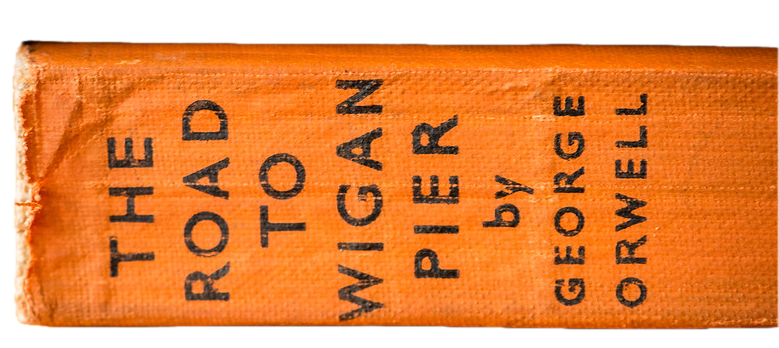
History is complex and paradoxical. One of the reasons Orwell has appealed to several generations of readers is the willingness in which he challenged his own team’s orthodoxies, rarely a popular move. The Left Book Club published The Road to Wigan Pier (1937) and many members, including the editor (who felt obliged to write a denunciation of sorts on the foreword) were angry at his insights into the hypocrisy of it all:
“Every left-wing ‘intellectual’ is, as a matter of course, an anti-imperialist. He claims to be outside the empire-racket as automatically and selfrighteously as he claims to be outside the class-racket. Even the right-wing ‘intellectual’, who is not definitely in revolt against British imperialism, pretends to regard it with a sort of amused detachment. It is so easy to be witty about the British Empire.”
The challenge and hard truth as he perceived it:
“The alternative is to throw the Empire overboard and reduce England to a cold and unimportant little island where we should all have to work very hard and live mainly on herrings and potatoes. That is the very last thing that any left-winger wants. Yet the left-winger continues to feel that he has no moral responsibility for imperialism. He is perfectly ready to accept the products of Empire and to save his soul by sneering at the people who hold the Empire together.”
There are many examples one could cite of similarly hypocritical poses adopted by contemporary politicians, intellectuals and individuals who loudly express their disapproval of (supply your own list) but enjoy the benefits accrued by having a privileged position in the system.
Orwell’s writing demonstrates an extraordinary ability to be simultaneously in the mind of both the oppressed, and the oppressor. Orwell had played both roles himself. Famously, after being a cog in the imperial machinery of empire in Burma, he went “down and out” and experienced life as a tramp. He was educated with the ruling class at Eton College but served with an anarchist militia in the Spanish Civil War and wanted to abolish the kind of privileged school he attended. He also organised for his own son to go to such a school.
The sins of the past do need to be understood and addressed rather than strategically ignored. Individuals who stand firm against the tide of events are rare creatures. Professor Dame Mary Beard’s speech to the Royal Society a few years ago is worth quoting:
“… it has become very clear that our students in school are not learning enough about British colonialism, how it came to be, and its consequences. But I also think that we’re not teaching how enormously complex the subject truly is (which is not to let imperialism off the hook!).
The complexities of education Let’s take one row about William Gladstone to illustrate my point. Gladstone was a major social reformer and without him, Britain would look very different, and probably worse. That is a fact. But it is also a fact that, through his family, he profited from slavery. Both of those things are simultaneously true, and yet too often they are presented as conflicting pieces of information. His life, his role and the history of the Gladstone family is complicated.
And when, done right, History teaches you not just the complexity of Gladstone, but also the complexity of history. And everyone – including the person on the street – is enhanced by an understanding and appreciation of this. I do think that you can teach that in history. It’s a skill – it’s an understanding – that schools and universities can teach. This in turn illustrates an important point: that it’s very dangerous to think that what we’re looking for in any such debate is simply the right answer. We can never get it right.”
The study of literature, history, art and philosophy is important for grappling with the moral complexities of the past and more importantly, those we face today. Considering the current state of the world, it feels like little progress has been made ensuring the rich and powerful do not abuse their privilege. In the year after Orwell died, William Faulkner published Requiem for a Nun which contained his most famous epithet:
“The past is never dead. It’s not even past.”
REFLECTION
The highs and lows of archival research are extreme ones. There are painfully long stretches of time when it hardly seems worth opening the next box or folder; indecipherable handwriting on awkward parchment documents, diaries or letters seemingly insurmountable challenges. However dull or frustrating the work becomes, the memory of past success motivates curious researchers to push on obsessively, ignoring eye-strain and physical tiredness in the hope of uncovering something special. Maybe a window will open, the fog of the past clear and the long dead speak from the archival page.
When this happens and something brilliant comes to hand, seeing the world imaginatively through someone else’s eyes in letters, diaries and various personal records uncovered in archives or libraries does put “flesh on the bones”. However, it has been a long time since I believed that study leads to the right answer in the sense Mary Beard explained in her speech for the members of the Royal Society.
Endeavouring to understand the people and the historical period leads to more complexity and often more melancholia at the human condition revealed in a poignant moment when a source reveals itself.
How does one feel about Lady Mary’s anguish over the death of her eldest son and heir who died trying to suppress the revolt of enslaved people? She is a mother, her son – who she encouraged to enlist – is dead.
It is one sad story among many, more terrible tales found in the Archives.
REFERENCES
Beard, Mary, “Education, like History, is complicated – and that’s ok”, The Royal Society, 2022
Coppard, Audrey & Crick, Bernard, Orwell Remembered, Ariel Books, 1984
Moore, Darcy, “Dear Charoux”, Peter Davison Award Presentation, University College London, 24 October 2024
Orwell, George, The Road to Wigan Pier, The Complete Works of George Orwell – Vol. VI, Davison, Peter (ed.) London: Secker & Warburg, 1997
Wynne, Elizabeth, The Wynne Diaries, Volume 2: 1794-1798, Oxford University Press, 1937

Discover more from Darcy Moore
Subscribe to get the latest posts sent to your email.