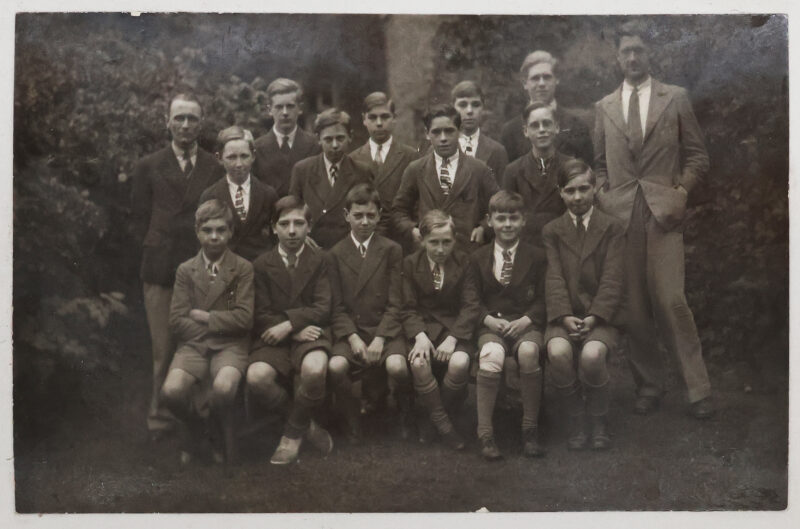
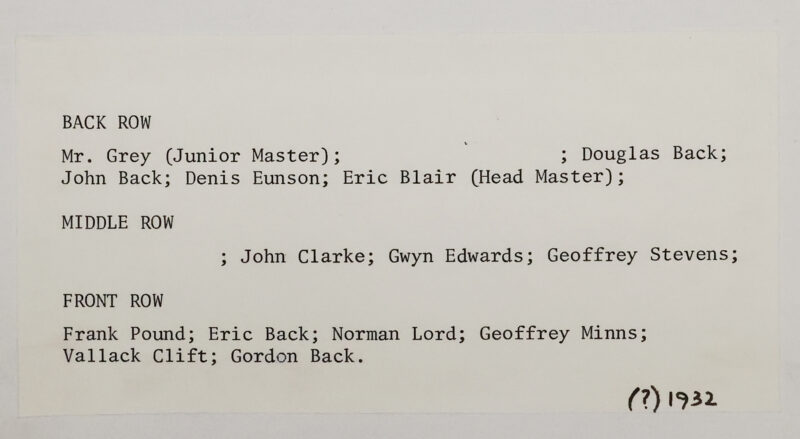
“The performance lasted only half an hour, but we spent hours in preparation, finding props, constructing the scenery etc., all of which [Orwell] supervised closely. It was ambitious. He arranged for plywood doors on either side to have saw cuts made in them so that Cromwell’s men could break them open with their pikes. It worked perfectly and made a great crashing noise coming down.” Geoffrey Stevens
“The miserable school play over which I had wasted so much time went off not badly.” George Orwell (in a letter to his literary agent)
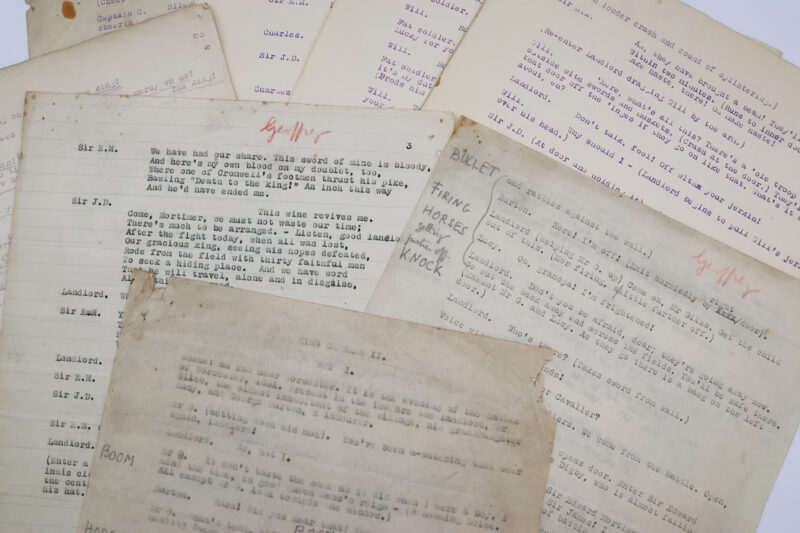
If you have a spare £45 000, King Charles II, a school play written by Eric Blair (while employed at Hawthorns High School for Boys) is for sale at Lucius Books. The play was performed at St Mary’s Church Hall in Hayes on the 20th December 1932 by Mr Blair’s class.
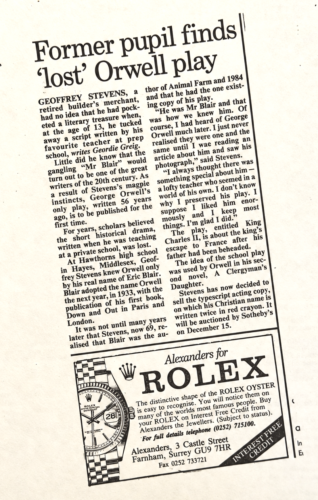
One of his pupils, Geoffrey Stevens, who found Orwell “the best teacher I remember at the school” and “the oddest man” he ever met in his life kept the script, eventually auctioning it at Sotheby’s in 1988.
Why did Orwell decide to write a play set in 1651? One assumes he was teaching the class about the civil war period (1642-1660) and restoration of the monarchy.
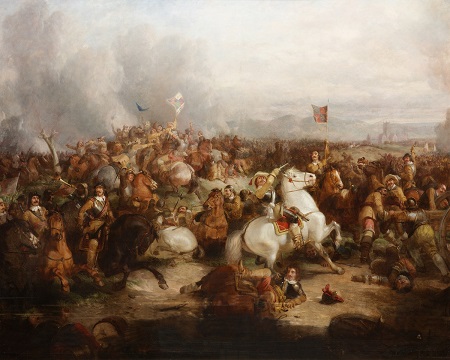
King Charles I had been executed in January 1649. His heir landed in Scotland in June of the following year, was proclaimed King Charles II and recruited an army of Scottish loyalists. This led to Oliver Cromwell invading Scotland where he won an important victory at Dunbar in September, 1650. Charles II, gambling that English royalists would rally to him, marched south but their failure to rise in sufficient numbers left his army heavily outnumbered at Worcester. Cromwell’s forces were victorious and Charles was forced to flee to France. This was the last major battle of the English Civil Wars (or possibly more accurately, the Anglo-Scottish War).
Orwell’s understandably ahistorical school play is set on the night of the Battle of Worcester and in Bristol the following day. Bernard Crick, one of Orwell’s biographers, made the observation that Christmas plays in the Church Hall were important advertisements for private schools but also noted:
“What is interesting, however, is that Blair took the Royalist side against, so the play implies, the miserable, narrow-minded, kill-joy, life-hating Puritans. That this was not tongue in cheek to please the royalism of the suburbs is suggested by Richard Peters’ memory that Blair told them that he would have favoured the Cavaliers against the Roundheads. In A Clergyman’s Daughter the school play also involves Charles II and Oliver Cromwell, who is made to sound ridiculous in the children’s words and accents. (Alt! I’olda pistol in my ‘and.”) On the edge of socialism though he was, there was still something to his joke — was it? — to The Adelphi staff that he was a “Tory anarchist”. Richard Rees was to use the phrase of him, and Orwell was to use it of Swift.”
William T. Blair (who won the script at Sotheby’s auction in 1988) wrote an insightful appraisal of the play about Orwell’s Royalist bias:
“Orwell achieves a pro-Royalist, anti-Puritan posture in a number of very practical ways. First, in terms of raw figures, the number of characters in the play who support Charles II is overwhelming. The play calls for fifteen speaking parts; nine, or a full 60 per cent of these, show demonstrable assistance, or agree with that assistance, in aiding Charles’s flight to France. Of the remaining six characters, four are entirely apolitical. This should not be surprising since the combined total of lines spoken by them is only sixteen. The final two characters are split in their sympathies. One, a soldier in Cromwell’s army, is not so much pro-monarchy as he is anti-Puritan. He states flatly and unequivocally that ‘there is too much duty in Cromwell’s army’. The only pro-Cromwell character in the entire play is a Captain Chambers, who leads the unsuccessful search for Charles throughout the play. Simply put, fourteen of the fifteen characters in the play show absolutely no allegiance to Cromwell’s revolutionary government. This results in the play’s tone of nostalgia for what has been lost and hope for what might again be one day.”
Blair (no relation to Orwell) saw some “biographical value” in the script and makes good points about the author’s “cynical awareness”:
“Before he had turned thirty, Orwell had revealed publicly what would prove to be a life-long affair with ‘political writing’. Furthermore, although it was written more for recreation than publication, the play exhibits Orwell’s cynical awareness of the self-serving motives of revolutionary governments. It is significant that at this early stage of his career as a writer, and long before his experience in Spain, Orwell’s political concerns should surface even in a school’s Christmas playlet…”.
There are some other biographical points to consider if one is interested in Orwell’s Scottish ancestry.
Scottish Blairs
While researching Orwell’s Scottish ancestors, a reference to his great-great-great-great-great grandfather instantly made me think of the play. Andrew Blair (d. 1699) was “a great loyalist” who accompanied King Charles II to the ill-fated, “unhappy battle of Worcester” but “had the good fortune to make his escape, and lived retired till the restoration”.
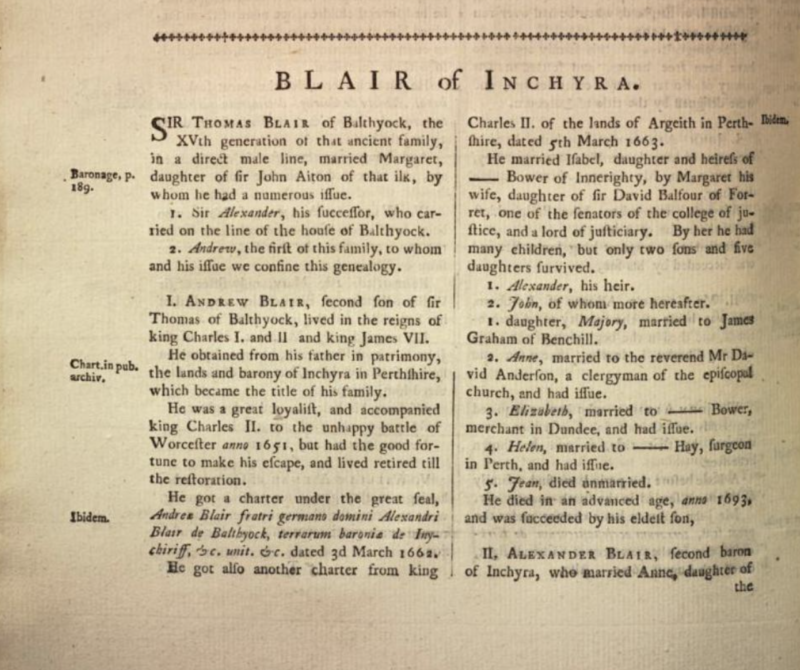
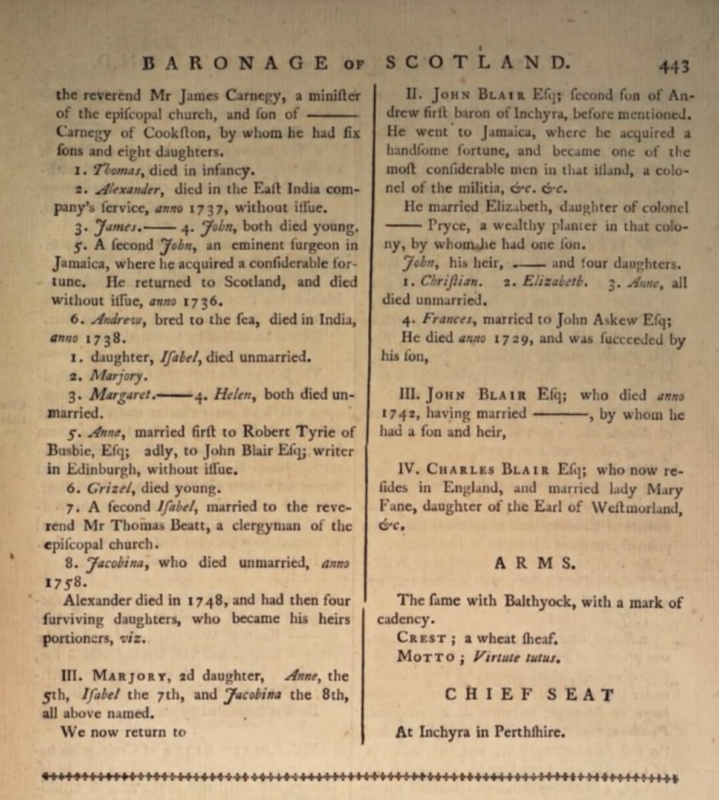
A primary source, dated 15 April 1653, reveals Andrew Blair of Inchyra was taken prisoner at the battle and that Sir Alexander Blair of Balthayock, (successfully) petitioned “the commissioners of the commonwealth” for his brother’s release:
“Petition by Sir Alexander Blair of Balthayock to the commissioners of the commonwealth to be exempted from attending to answer at the instance of his brother, Andrew Blair, a prisoner of war, for sums alleged due, and that by reason of his father’s death and urgency of his affairs & members granting permission.”
When restored to the throne, Charles II rewarded Andrew Blair’s loyalty with land (in 1662 and again in 1663): “Andreæ Blair fratri germano domini Alexandri Blair de Balthyock, terrarum baroniæ de Inychiriff”.
Andrew Blair (d.1699) was the father of Colonel John Blair (1668-1728) who had survived the disastrous Scottish attempt to establish a colony at Darien. Colonel Blair was a slave-owner and politician in Jamaica. His will (1728) reveals continuing connections with his family in Inchyra.
For some time now I have speculated (and been accumulating evidence) that Orwell knew much more about his ancestors than previously understood. It is probably a coincidence that Orwell chose to write a play about King Charles II and this significant battle in British history but one cannot help but note that Richard Peters, another schoolboy who Orwell impressed, observed that his tutor was temperamentally “a cavalier”:
“I remember him saying that he would have sided with the Cavaliers rather than with the Roundheads because the Roundheads were such depressing people. And I can now understand what he meant. For temperamentally he was a Cavalier, lacking the fervour and fanaticism of the Puritan. Like most people who have thought out clearly where they stand, he did not make a fuss about it.”
King Charles II
Orwell’s school play has had a surprising afterlife.
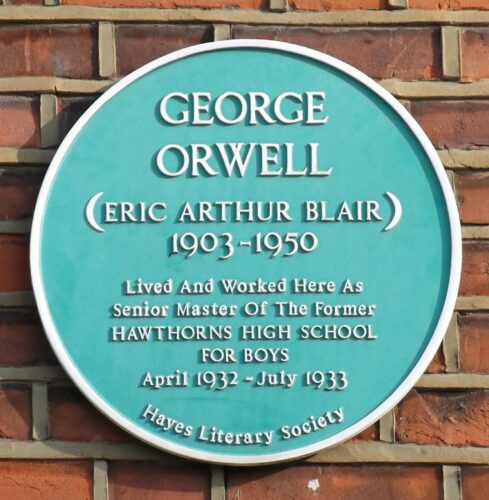
The media extensively reported the sale of the script in 1988 and a plaque, organised by the local literary society, can be located on the site where Orwell worked as a teacher in Hayes.
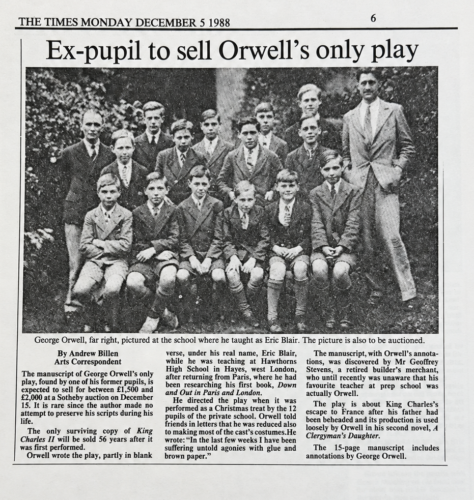
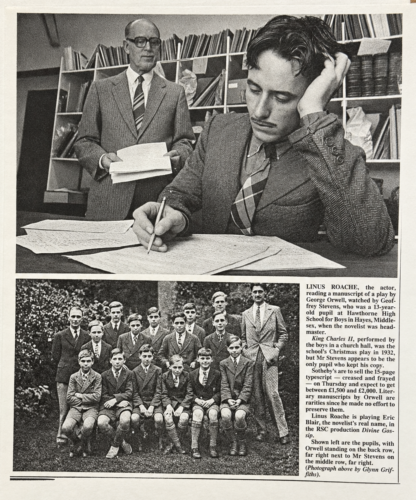
Believe it or not, King Charles II was performed for a second time in Hayes during April 1992 by Compass Arts Theatre. I am trying to ascertain if there is footage of the performance.
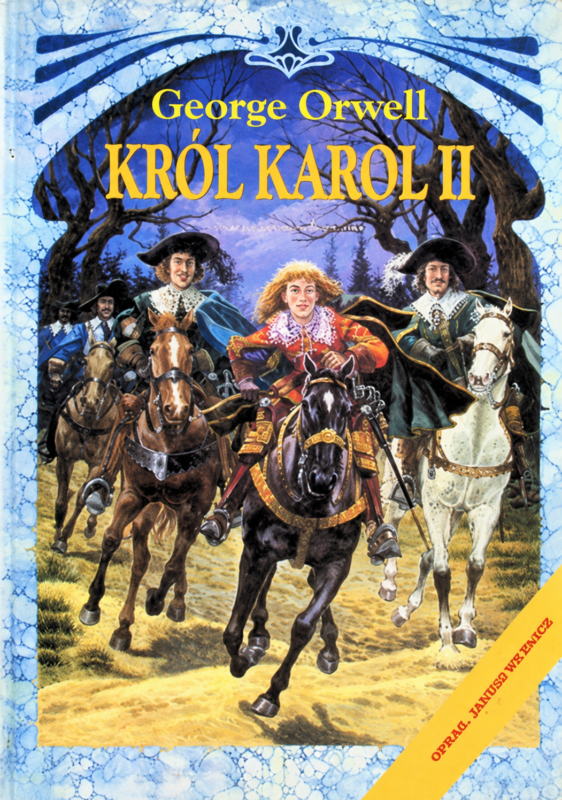
Surprisingly, the play was translated into Polish by Bartolomiej Zborski and published in Warsaw as Król Karol II in 2000 with a suitably boy’s own adventure look to the cover.
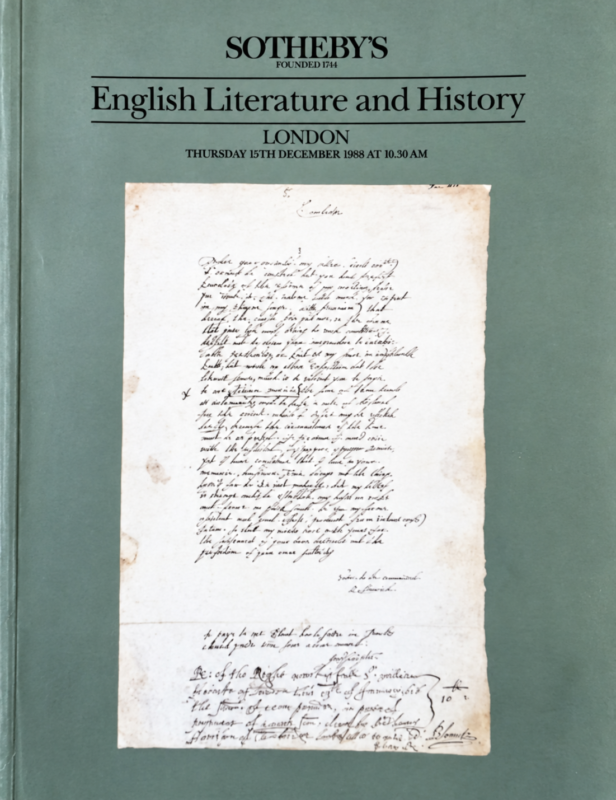
The script currently for sale is sadly not affordable but at least I have added the Sotheby’s catalogue from 1988 to my Orwell Studies Library.
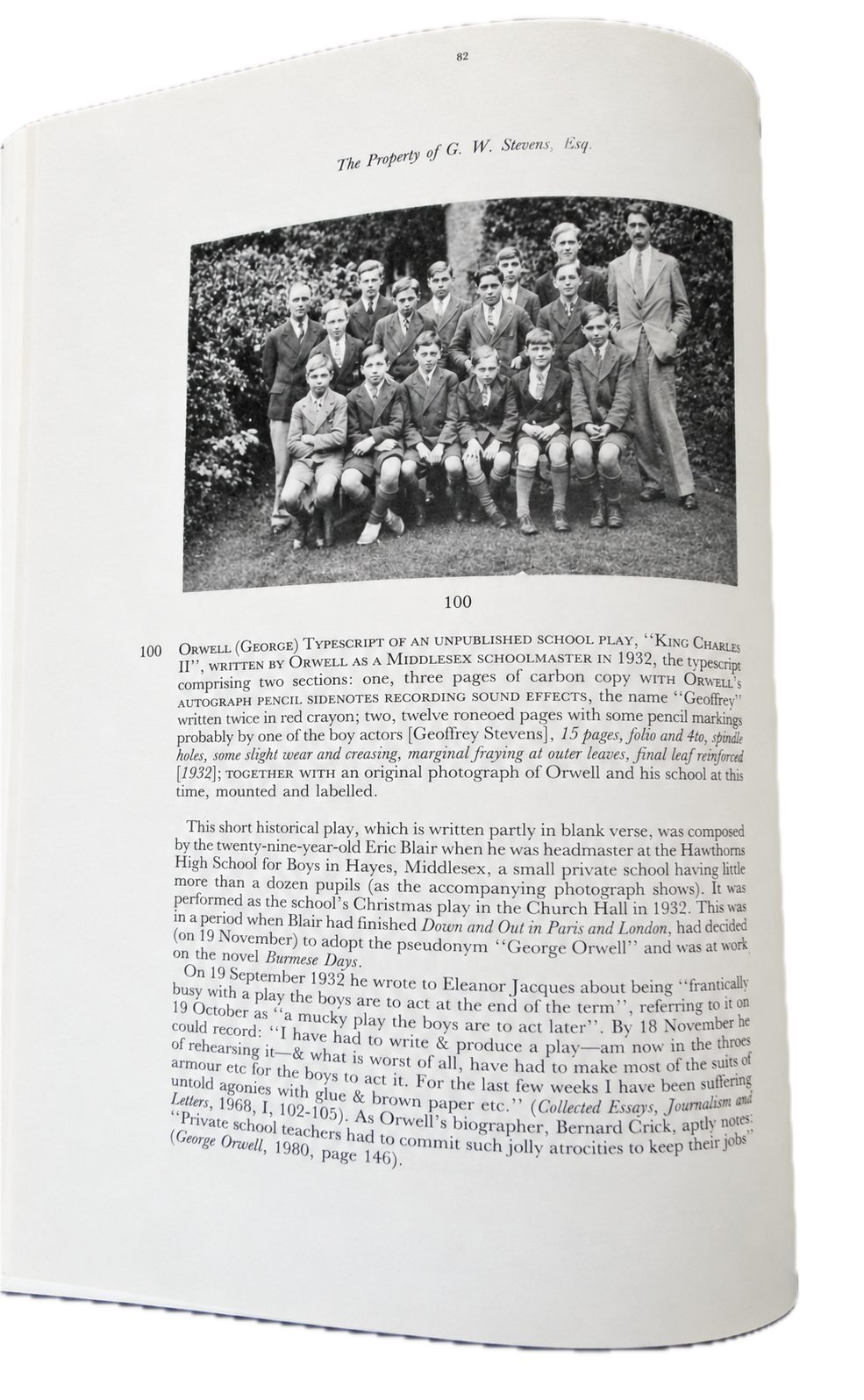
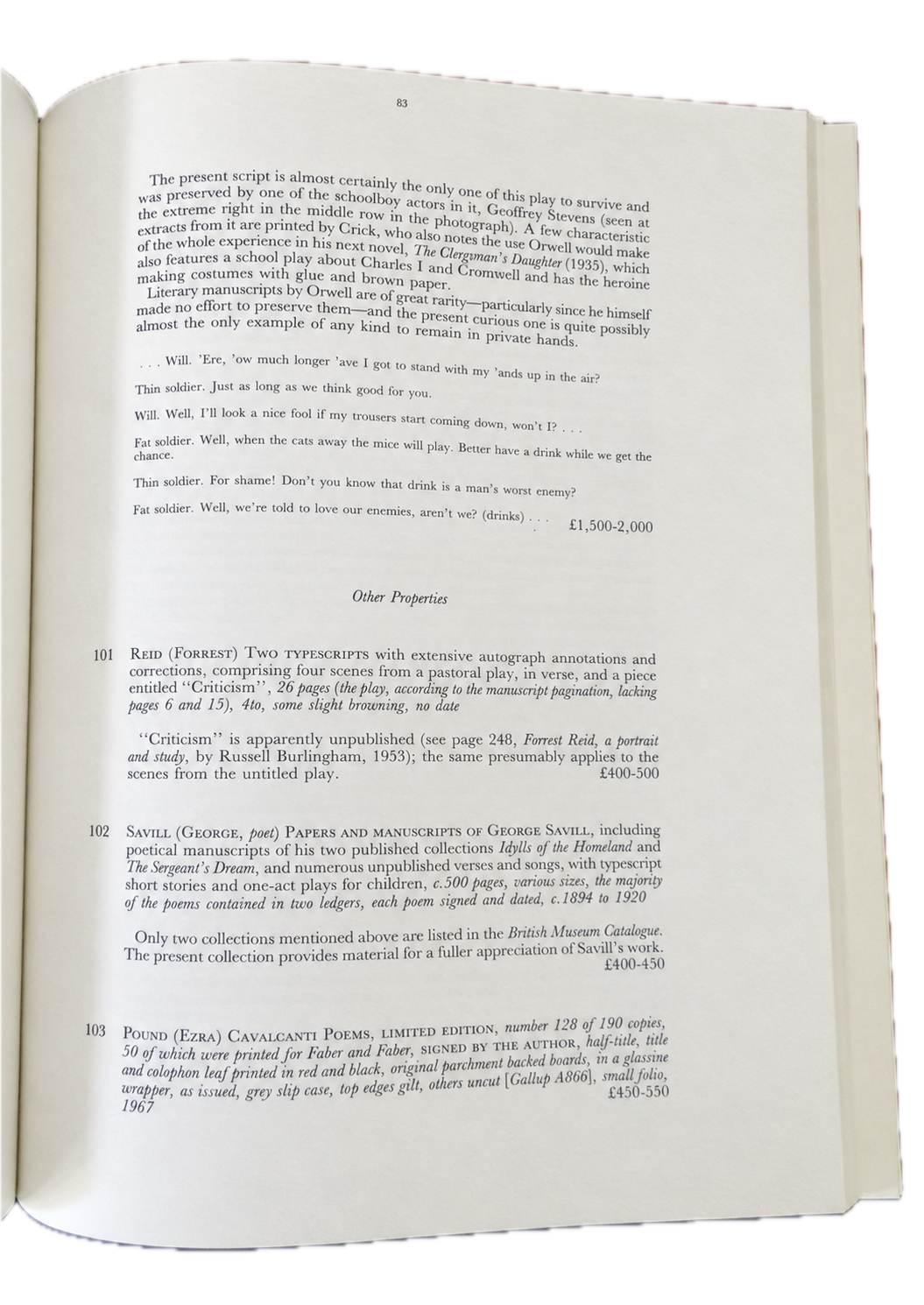
ACKNOWLEDGEMENTS: Thanks are due to Gordon MacGregor for his generous assistance and to James from Lucius Books for kindly supplying images for this post.
FEATURED IMAGE: The Battle of Worcester in 1651 by Thomas Woodward
REFERENCES
Blair, Sir Alexander of Balthayock, “Petition for exemption from attendance in a debt claim brought by his brother Andrew Blair, a prisoner of war, with permission granted, 15 April 1653”, Clan Blair Society Collection, Mss-639, Box 4, folder 77, R. Stanton Avery Special Collections, New England Historic Genealogical Society, Boston
Blair, William T., “George Orwell’s ‘King Charles II’: An Early Criticism of Revolutionary Government”, The Review of English Studies, August 1990, New Series, Vol. 41, No. 163, pp. 370-373
Coppard, Audrey and Crick, Bernard (1984) Orwell Remembered, London: Ariel Books/BBC
Douglas, Robert, The Baronage of Scotland, Containing an Historical and Genealogical Account of the Gentry of that Kingdom, Edinburgh, 1798
Independent, 9 December 1988
Orwell, George (1998 [1903-1936]) A Kind of Compulsion: The Complete Works of George Orwell, Vol. X, Davison, Peter (ed.) London: Secker & Warburg
Orwell, George (tr. Zborski, Bartolomiej), Król Karol II, Warsaw: Dom Wydawniczy Bellona, 2000
Powell, Anthony (1967) “George Orwell: A Memoir”, Atlantic Monthly, CCXX, October pp 62-68
Shelden, Michael (1991) Orwell: The Authorised Biography, London: Heinemann
Sotheby & Co, Sotheby’s English Literature and History Auction Catalogue: 15th December 1988, London: Sotheby & Co., 1988
Sunday Times, “Former pupil finds ‘lost’ Orwell play”, 4 December 1988
Times, “Ex-pupil to sell Orwell’s only play”, 5 December 1988
Wadhams, Stephen (1984) Remembering Orwell, Harmondsworth, Middlesex: Penguin

Discover more from Darcy Moore
Subscribe to get the latest posts sent to your email.
Douglas Kerr
Interesting that as far as I can make out from the photo of the typescript, Blair has his posh characters, Sir E.M. and Sir J.D., speak in blank verse (unrhymed iambic pentameter) while the lower-class landlord speaks in prose, on the Shakespearean model.
This is not exactly aesthetically radical! Compare the early dramas of that other temporary schoolteacher W. H. Auden.