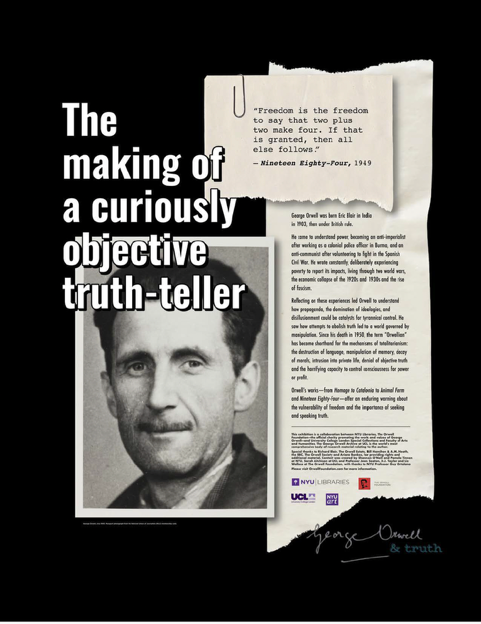
“But the thread that runs through all of Orwell’s writing is his obsession with getting to the truth. If it meant trashing friendships or jeopardising his own success, so be it. In the political magazine Tribune, he wrote in 1944 that ‘almost nobody seems to feel that an opponent deserves a fair hearing or that the objective truth matters.’ With those words ringing in our ears, and with the unparalleled resource of University College London’s George Orwell archive at our disposal, we set off in search of partners who might recognise the importance of amplifying this message at this moment. Happily, we found them at NYU.”
Liz Wallace, Director of The Orwell Foundation
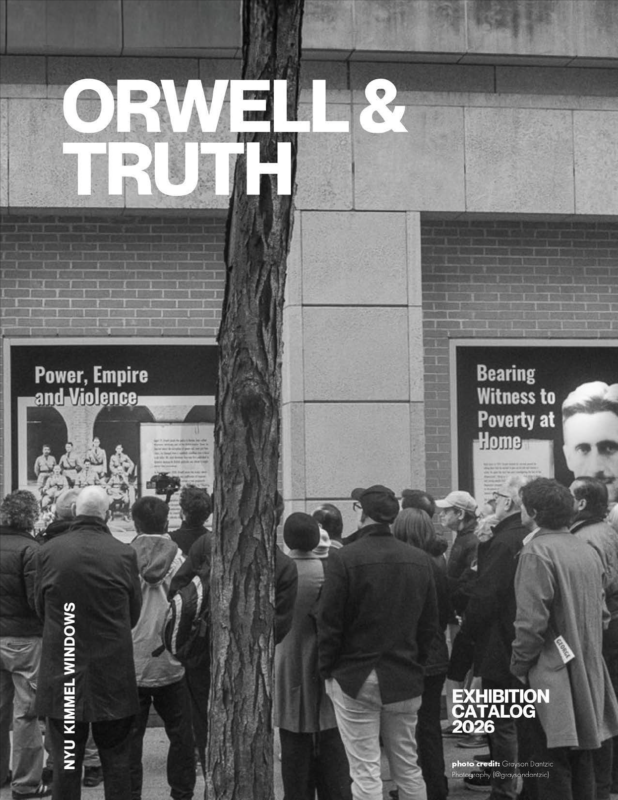
Sadly, I will not have the opportunity to visit the Orwell & Truth Exhibition at NYU Kimmel Windows, in the heart of Greenwich Village, which opened back in March and runs until the 1st December. I do have the catalogue though and Liz Wallace’s introductory comments absolutely capture why Orwell appealed from my first experiences reading his work as a teenager.
The lead curator of the exhibition, Pamela Jean Tinnen, also speaks to my love of Orwell’s work:
“When we are willing to see the world as it truly is — unflinching, clear-eyed, without the comfort of convenient fictions — we find something unexpected waiting on the other side: the courage and conviction to imagine what humanity might someday become. That is what Orwell offers us, still. Not simply a warning, but an example. And perhaps, if we are brave enough to follow it, there lives something very much like hope.”
Liz and Pamela – by focusing on Orwell’s “obsession with getting to the truth” and “unflinching” disregard for “the comfort of convenient fictions” – clearly understand what made him different to most human beings and an exceptionally gifted writer.
The exhibition has “thirteen windows” on “Orwell’s life and creative vision” designed to appeal to those who know little of the man OR have “read every word he wrote”:
- The Making of a Curiously Objective Truth-Teller
- Orwell’s Youth & Upbringing
- Bearing Witness to Poverty at Home
- Power, Empire and Violence
- All Propaganda is Lies
- Nature & Nurture
- Orwell & the BBC
- Fascism & Ideology
- Orwell’s Life & Time
- The Politics of Language
- “I’ve Had It Coming All My Life” — Comment by Orwell on His Deathbed
- Private & Personal
- Orwell’s Legacy
The focus is on “where, when and how Orwell developed the interests, experience and characteristics that made him this most exceptional of writers” and “the dangers of unchecked power and excessive limits on freedom of expression…”. Who could disagree with the idea that the importance he attached to truth demands “the forensic attention of us all today”?
The Freedom of the Press, Orwell’s introduction to the Ukrainian edition of Animal Farm, not published in English until 1972, has some of his most powerful assertions about censorship and “vested interests”. Orwell points out that the “British press is extremely centralised, and most of it is owned by wealthy men who have every motive to be dishonest on certain important topics”. My favourite line, which is still as true as when he wrote it:
“Anyone who challenges the prevailing orthodoxy finds himself silenced with surprising effectiveness. A genuinely unfashionable opinion is almost never given a fair hearing, either in the popular press or in the highbrow periodicals.”
Orwell understood that what one said “might possibly be true” but considerations and warnings about how this truth “played into the hands of this or that reactionary interest” powerfully incentivised self-censorship.
As Liz Wallace points out in her introduction, Orwell’s obsession with truth-telling – even when “it meant trashing friendships or jeopardising his own success” – was of greater more concern than these other personal or professional considerations. This is what made him different. There are generations of writers who have endeavoured to follow his credo. It is never easy.
The history of the The Orwell Foundation – an independent charity dedicated to “promoting George Orwell’s legacy” – is fascinating one and well worth reading. Their mission statement includes:
“Whether through the prestigious Orwell Prizes, our stimulating events programme, or our innovative Youth Prize, we work to bring to life George Orwell’s vision of a decent society where thought is free, truth is valued and brave writing is celebrated.
An independent charity, we champion plurality of opinion and ideas by running prizes and events which nourish courageous writing, and connect with audiences – from policy experts to school children – on subjects emerging from George Orwell’s works including poverty, totalitarianism, the corruption of language and the rise of new technologies.”
You can sign-up to their newsletter and become “a friend” or “patron” here.
The QR code link below to this Youtube channel does not currently have any footage of the exhibition or walking tours but perhaps they will be added. I will check again next month. However, you can see the intended content, including the curator’s talk at the opening reception and walking tours here.
Q. Have you had the opportunity to visit the exhibition? Please consider posting a comment below.
REFERENCES
Orwell & Truth – Exhibition Catalogue, 2026
Sincere thanks to Pamela Jean Tinnen for permission to post the catalogue pdf.

Discover more from Darcy Moore
Subscribe to get the latest posts sent to your email.