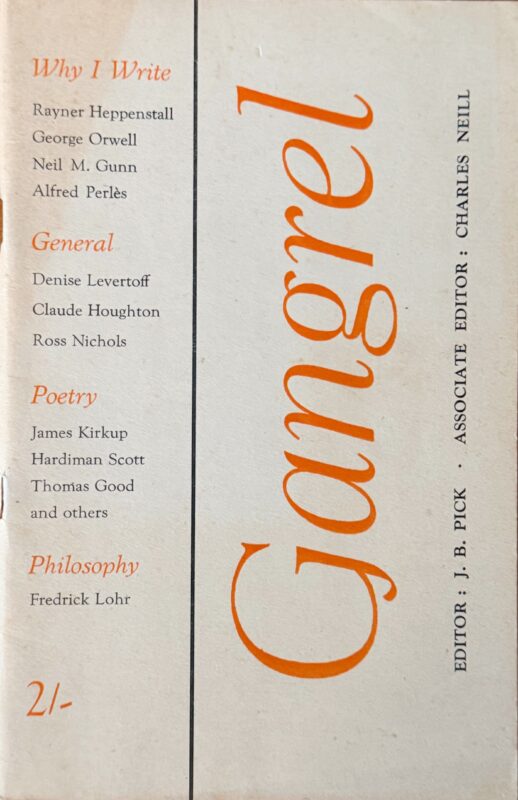
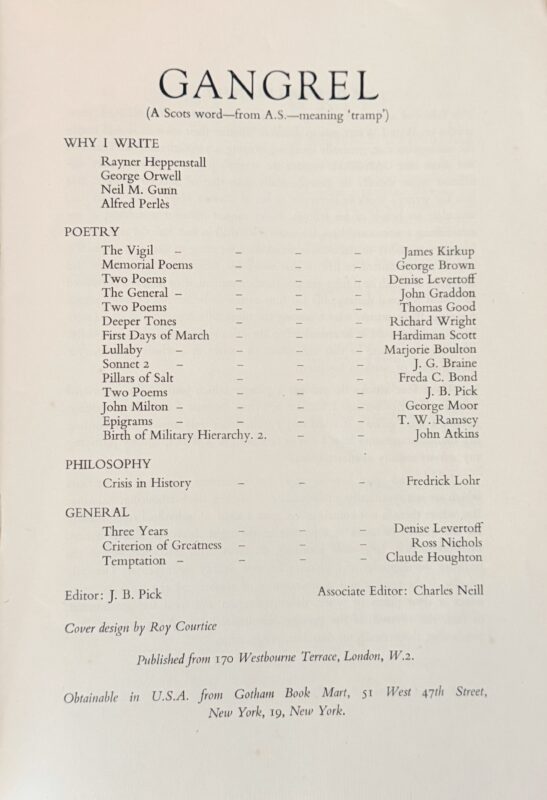
4. ALFRED PERLÈS – WHY I WRITE
Gangrel, Number 4, Summer 1946, pp. 12-15
Frankly, I don’t know. I thought I knew, but I don’t. Moreover, come to think of it, the question is only superficially fair. Which, incidentally, is the case of any primary question. No one can say with intrinsic truthfulness why he does a certain thing if the compulsion to do it comes from the barred regions of the unconscious to which there is no access whatever. I might as well try to answer the question, Why I live.
Even the obvious answer, I write because I must, seems glib albeit exaggerated. For I mustn’t, really. I think I could stop writing to-morrow, or this very minute, without appreciable ill effects on my psyche; as easily as I could stop smoking. But I like to smoke, and I like to write. Only in the case of writing it is not merely a matter of liking. The urge to write, unlike the urge to smoke, does not satisfy by yielding. On the contrary, yielding to that urge perturbs me, it often disorientates and bewilders me; it seldom satisfies me, and never compensates me entirely for the loss of something to which literature I vaguely feel, is a mere substitute.
This is about the crux of the problem: literature is approximation, at best; (at worst, it is, of course, only another trade); it is difficult to put the finger on it. There is always that itching discrepancy between inspiration and execution, the flash and what becomes of it. The image, the metaphor, are typical examples of this discrepancy. In fact, it often seems to me that this very discrepancy determines the degree of art in literature. Literature in its highest form, poetry, is distilled imagery. Distillation is elimination, and elimination is sacrifice. The great writer is essentially of a sacrificial nature.
But this is neither here nor there. I have been asked why I write, and I have admitted that I don’t know. Or do I? Search me. I am searching myself. The vocation of the writer is so deep-rooted, so deeply embedded in the fabric of the unconscious that no radar can locate it. The chances are that the urge, the inner compulsion, to write is not due to one particular kink in the psychic make-up of the writer, but to several, each of them equally untraceable.
There is, of course, the ego which clamours for assertion. But the ego can assert itself in a number of ways of which writing is only one, and by no means the most adequate. The writer depends on miracles, the ego doesn’t. Writing is a miracle, always. Water springing from rock. It’s baffling and mysterious because the source is unknown. But the source is there just the same. Writing is a matter of seeking. When I write I am desperately seeking I don’t know what: possibly something I have forgotten or lost, or never possessed. And whatever I find is not the thing I am seeking. The seeker who finds what he seeks stops seeking. I can never stop writing because I only find approximations, similes, metaphors, images, flowerpots. As a writer, I am an approximation hunter. I never write to express anything or myself (this is done accidentally and incidentally), but because I am desperate for I do not know what: I write because I am in despair. All of which does not explain why I write.
In a minute, perhaps, the thing will clarify. Clarify! That might be a clue. Writing, perhaps, is a form of clarification. The unconscious is the vast, the endless, the inexhaustible source: the myths and the legends are there and all the primal fears, hates, loves and hopes; the prechaotic dream-being filtering through the carburettor of the writer’s mind. In the camera obscura of the unconscious, which represents a sort of Noah’s Ark containing specimens of all the denizens of prehistory, the writer is at work, groping, groaning, despairing, yet hoping. The images spring like sparks. Out of the alembic of the mind, the metaphors dance like homunculi, and are being trapped and captured as they emerge for the sole purpose of vanishing, as quickly as possible, into the dark substance of prehistoric past. And I know that I write because I am condemned to sentry duty at the vanishing point, to intercept the friendly and alien images. But what I seek I do not find. I confess to being addicted to this perpetual search. It does not get me anywhere, but it keeps me afloat and mildly optimistic. Dwindling hope is ferocious, like a hungry wolf: I am lean and hungry, like a wolf. For better or for worse, I shall always be a writer. But why?
The question really ought to have been, Why do I write this way or that? It’s a more reasonable question because more answerable. More answerable because it involves, and implicates, our good, old friend, the ego. We can always say why we are doing a certain thing in a certain way because we’re doing it ourselves, deliberately, consciously: with our own mind: or subconsciously, with another department of our own mind. The way I write is my own copyright. I’ve made it up myself. Here I cannot blame things on the unconscious, for I am lord and master. I go fifty-fifty with my ego, of course, and we get along fine. We both have a say in the matter and moreover, we act in full agreement and accord.
Here the lower forces enter into play. The elementals are admitted, the powers and principalities meet on common terrain. They’re all gathered together: pride, vanity, technique, cunning, school, appetite, frustration, philosophy, the classics, religions, psychoanalysis, the Beggars’ Opera and Mickey Mouse. I deploy my forces for I am the great general, the greatest of all times. No one has a say in the matter but I: I am producer, director, stage manager, script-writer, prompter, sound-track operator, hair-style expert, fashion designer, publicity director, director of olfactory premonitions, president, vice-president, chairman, office boy and pope all rolled into one. It’s all up to me and I wouldn’t have it otherwise. My ego prompts me, of course, but every once in a while I go one better than my ego, and the ego is overjoyed. We work hand in hand, like a couple of hold-up men or confidence tricksters. We cannot cheat each other because the cards are on the table all the time.
Our chief concern (mine and my ego’s) is to sponge on the Source. We feel we are both trustees in a remote sort of way, so we hold on to everything and give away nothing that is not in one way or another recoverable. We are not worrying so much about royalties, we’re out for splendour and magnificence. Witticisms and small passions are our meat. Now and then a dash of mysticism or pornography in lieu of pepper and salt. We never forget the spice of the programme. We are caterers, after all, and it is imperative that we satisfy our clientèle. Ours is a firm of old standing: Perlès & Ego, Ltd., Second-hand Ideas and Flowerpots. Maison de confiance. Founded in 1897. Capital assets nil. Depositors are invited. Rates of interest guaranteed. Our books always open to inspection. We are our own chartered accountants. Ladies are treated with courtesy. You can trust us. All we want is three meals a day, and we never eat for more than two. The best trade references at your disposal and we don’t keep expensive women.
Now it is rather indelicate to say such things about ourselves, my partner is sure to complain at our next board meeting. However, I take a little time off now and then. The present article is written on one of my sporadic holidays, so I can let you have an irrecoverable mouthful in which my partner has no responsibility. I am the naked I. And I am a little sad. I have a longing to plunge back into the Source, but I am a coward. Besides the Source may not want me yet. It isn’t that I am disinclined to double-cross my partner, whom I still need but whom I despise nevertheless. He probably has a similarly low opinion of me, but is quite unable to voice it without my help, and I don’t see why I should assist him to slander me. For once, I’ve got him by the balls.
When I am thus alone with myself, the whole business of writing becomes a little clearer to me, and I can examine more critically my own work. It may be puny, but that in itself does not matter. Whenever I do the best I can possibly do, I ought to be satisfied. But am I? No. Oddly enough, it’s the best I have written (in my own opinion, of course), which leaves me with that itchy aftermath of discrepancy I mentioned a little while ago. There are some truly magnificent pages in my earlier books written in French, if I may say so without false modesty, but it is precisely those pages that now, in retrospect, almost posthumously, as it were, hurt me most. There is a leakage in my subconscious: whole images come to me, almost ready-made, like vignettes, and all I have to do is to transcribe them. It’s like looting. The images come to me when I want them, when I call them, like trained pigeons. They come to me naturally, like milk to a mother’s breast; they come apparently from nowhere, but they come. The weird miracle of gestation all over again. The creation comes from elsewhere: I am only the middle-man, the intermediary, the lightning conductor: I do nothing, I am recipient only. The image comes truly from me but I can no more call it mine than the twig I cut from a tree. And the best lines I’ve written are twigs from other trees; they originate in a realm upon which I have been, and still constantly am, trespassing.
I can only scratch myself. The more it itches the more do I scratch myself, and the more I scratch myself the more does it itch. What an appetising vicious circle! I am a victim of the epitome. The discrepancy between flash and creation. If the flash could be held, or only made to last a little longer, as is done in some slow motion pictures, creation would become infinitely more divine. But the flash flashes across the conscious mind and darkness falls immediately afterwards: one milestone for I don’t know how many thousand miles. The best I’ve written was written in twilight. That’s where the human creator falls down. Only God is the perfect creator because He sees what He is doing. God is Light. And if He throws me a flash once in a long while, like a bone to a hungry dog, I am supposed to be thankful. Thank you, sir! But as a writer and creative artist, I am a small god myself, a competitor, a revoltee, a collaborator or a resister. I have a legitimate claim to more light! I could get light from other quarters of course, but unfortunately it is dangerous ersatz which affects the vision. Only the real light is good enough for me. As an anti-force, I should cut a poor figure . . . a village chemist compared to the I.C.I. And as a member of the ptochocracy of creative artists, I am dependent on His hand-outs.
The idea is to give Him a hand. Not because I think He needs it, nor even hope He will ever acknowledge it, but simply because if He’s made me in His image, as I am told on good authority, He must have had a good reason for doing so. In which case I have the right and the duty to act as I act. I may be fooling myself, of course, as I have done on various occasions in the past, but it is my firm belief that there is a definite parentage between the powers and principles which operate in, and through, man and that higher force that has complete suzerainty over all else: the be-all and the in-all at the hub. And every creative impulse in man gravitates towards the hub. Creativity is like a currency coming from, and flowing back to, the same vaults: a utility like electricity that can never be expended, which neither increases nor decreases but simply is: the permanent frame within which you do your own embroidery: the loom that weaves the pattern according to our own design. Creativity is a force, creation merely a fashion. Being a creative artist gives me access to the pool of creativity, but what I create is my own business. My choice, if I ever had one, which is dubious, was to write. And that is why I write. BUT I STILL DO NOT KNOW WHY!
Offenbach-on-Main,
December, 1945.